The Business Case for Ending Manels, Not Just the Moral One
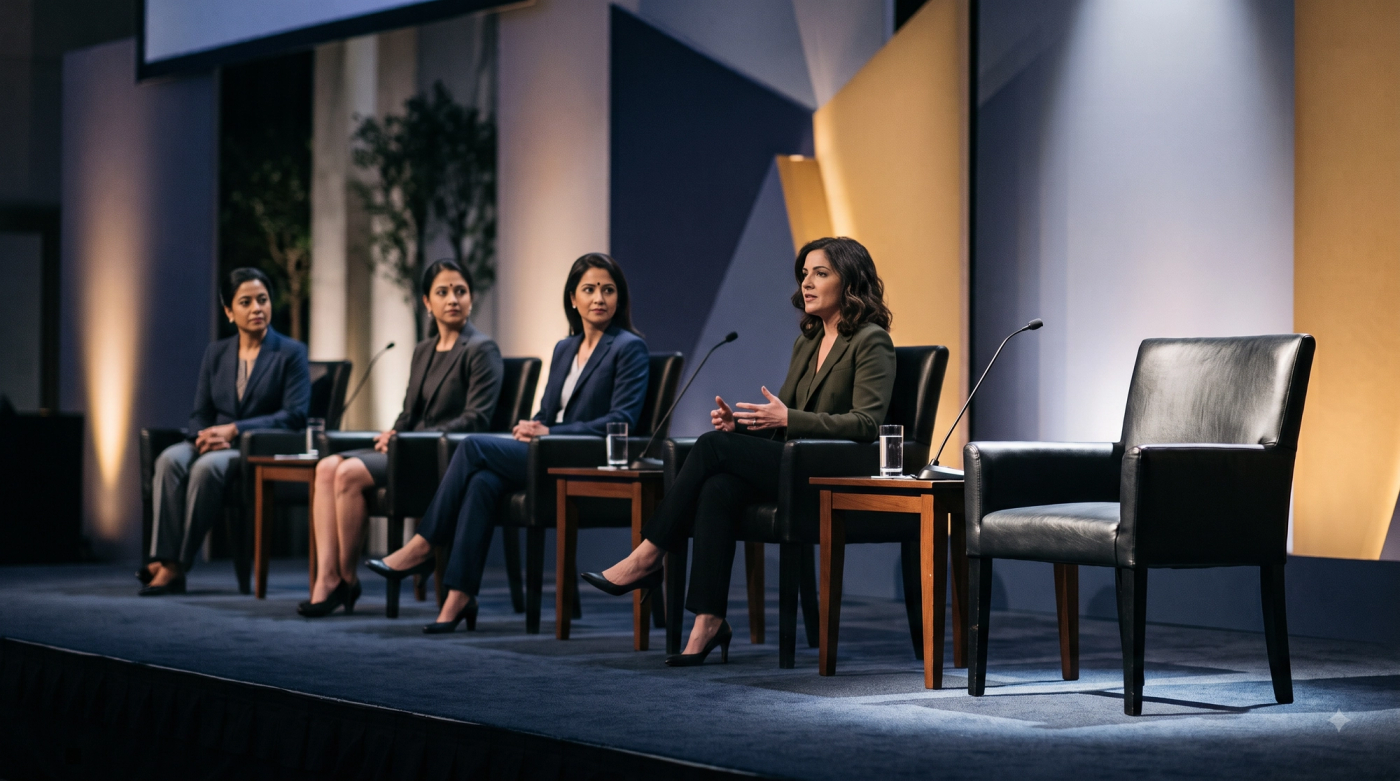
For years, the argument against all-male panels has been made almost entirely in the language of fairness. It is unfair that qualified women get passed over. It is unfair that the same handful of men keep getting invited back. It is unfair that "we couldn't find any women" is still an acceptable sentence to say out loud at a planning meeting in 2026. All of that is true, and none of it has been enough to fix the problem at scale.
There is a second argument that gets made far less often in India, and it does not rest on fairness at all. It rests on output quality. A growing body of research, most of it from outside the DEI literature entirely, suggests that homogenous panels do not just look worse. They think worse. They ask narrower questions, miss more of the available evidence, and arrive at conclusions that a more mixed group would have caught and corrected. If a panel's job is to produce insight, not just fill a stage, then a manel is not a representation problem dressed up as a business problem. It is a business problem, full stop.
What "worse discourse" actually means
The claim that diverse groups make better decisions is often treated as a soft, feel-good assertion. The research behind it is not soft at all. One of the more cited studies on this, run out of Northwestern's Kellogg School of Management, found that socially diverse groups outperformed homogeneous ones not simply because they brought fresh ideas to the table, but because the presence of difference itself pushed the group into slower, more careful information processing that homogeneous groups skipped. The mechanism is not that diverse panels have access to a wider pool of facts, though they often do. It is that homogeneous groups tend to feel unusually confident in their own performance and interactions, right up to the point where the diverse group has already outperformed them on the actual task. In other words, comfort and correctness pull in opposite directions. A panel of five people who already agree with each other feels efficient. It rarely feels like it is missing anything, right up until it does.
This matters for the specific format of a conference panel because a panel is, structurally, a live decision-making exercise performed in front of an audience. It is asked to weigh evidence, respond to a moderator's provocations, and arrive at some kind of shared or contested conclusion within forty-five minutes. That is exactly the kind of task the diversity-and-cognition literature has studied, just moved from a boardroom to a stage.
The visibility gap starts even before the panel begins
There is a second, quieter mechanism at work, and it shows up not in what panelists say but in who gets to speak at all once the panel starts. A peer-reviewed observational study of a large academic conference found that women asked roughly half as many questions as men over the course of the event, a gap that held even after the researchers controlled for how senior the person asking was. What makes the finding sharper is that the audience itself had reached gender parity that year, which rules out the simplest explanation, that there just weren't enough women in the room. The imbalance was not about who showed up. It was about who felt able to speak once they were there.
Translate that dynamic onto a panel stage rather than an audience, and the effect compounds. A manel does not just remove women's answers from the discussion. It removes the social permission for anyone in the audience, particularly women in the audience, to raise a dissenting question, because the visible cue in the room is that expert authority on this topic looks a certain way. The panel's composition sets the terms for the entire room's participation, not just its own.
Boards already have the receipts India needs
Skeptics of this argument tend to say that panel discourse is soft and unmeasurable, unlike a company's balance sheet, so the comparison to research on decision quality is a stretch. India's own boardrooms undercut that objection directly. A 2026 study using a comprehensive dataset of Indian listed companies examined what happened after the country's 2013 mandate requiring at least one woman director per board. Using a difference-in-differences design to isolate the effect from broader market trends, the researchers found firms saw measurable gains in both return on assets and return on equity after complying with the mandate, with the effect strongest at companies that had previously run entirely male boards. Crucially, the paper found the gains were not automatic just from adding a woman to the roster. The benefits showed up most clearly when the women directors brought real sector expertise and independence to the boardroom, which is the same standard Draupadi on the Dais applies to panel invitations: not a token seat, but a genuine subject-matter voice.
This is the part of the argument Indian conference organisers, sponsors, and ESG teams cannot wave away as a soft metric. If measurable financial performance moves when all-male boards become mixed boards, and the mechanism researchers point to is improved monitoring and decision quality rather than simple optics, there is no principled reason to assume a panel discussion is exempt from the same dynamic. A panel is a smaller, faster version of the same group decision-making problem a board faces. The stakes are lower, but the mechanism is identical.
The sponsor's problem, not just the organiser's
There is also a version of this argument that speaks directly to the people who fund these panels rather than the people who build them. Sponsorship budgets for large Indian conferences increasingly sit next to ESG reporting lines, and SEBI's Business Responsibility and Sustainability Reporting framework has made board-level and, increasingly, leadership-level gender composition something companies already have to disclose. A sponsor's logo on a five-person, all-male panel is a small but visible contradiction of whatever gender diversity commitments that same company is reporting elsewhere in its BRSR filing. That contradiction used to be treated as a reputational footnote. It is becoming a harder one to explain away, precisely because the research above gives critics a second line of attack beyond optics: not just "this looks bad," but "this is a company that says it values better decision-making and then funded a discussion structurally less likely to produce it."
None of this requires assuming bad faith on anyone's part. Most manels are not sponsored deliberately, they are sponsored by default, because nobody on the funding side asked the organiser who was actually on the roster until the invitations had already gone out. But a default is still a choice once it is visible, and increasingly it is visible, because attendees photograph panel line-ups and post them without being asked to.
Why the moral argument alone keeps losing
If the fairness case were sufficient on its own, manels would have disappeared from Indian conference stages years ago. They have not, and the reason is not that organisers are unusually indifferent to fairness. It is that fairness arguments compete against a scheduling deadline, a sponsor's short list of "safe" names, and an organiser's honest belief that they searched hard enough. Fairness loses those fights constantly because it is treated as a constraint on the real goal rather than as part of the goal itself. The homophily research behind why organisers keep landing on the same names explains part of why this keeps happening: people build shortlists from their own networks, and networks are more homogenous than the talent pool they are drawn from.
A business-quality argument does not have that problem, at least not to the same degree. If a sponsor's brand credibility is tied to a panel's output, and the output is measurably weaker when the panel is homogenous, then fixing the panel stops being a favour done for fairness's sake and becomes a defensible allocation of the event's own budget. That reframing does not replace the moral case. It gives the moral case a partner that can survive contact with a P&L review.
What this means for who gets the mic
None of this is an argument that any diverse-looking panel is automatically a good one. A panel with one woman moderating four men is not diverse in the sense the research describes, it is diverse in appearance only, since the moderator's job is to ask questions rather than hold an expert position that can be challenged or defended. The mechanism researchers describe, better information processing, fewer overlooked facts, requires that the added voices hold actual subject-matter standing on the panel, not a facilitation role adjacent to it. Senior women across Indian industries already hold that kind of standing inside their organisations. The gap is not credentials. It is that the people building panel shortlists are not looking past a small, familiar circle of names.
That is a solvable infrastructure problem, not a talent shortage. A searchable directory of vetted women experts, filterable by sector and expertise rather than by who happens to be top of mind, exists precisely to shorten the distance between "we couldn't find anyone" and an actual, qualified shortlist. Widening the search is a smaller ask than most organisers assume, and the research suggests the payoff is not just a better-looking stage. It is a better forty-five minutes of actual discourse.
The scheduling excuse also gets weaker the more often it is made. An organiser who "couldn't find" a woman expert on cybersecurity, climate finance, or venture investing for one event and then makes the same claim for the next one is not describing a genuine talent shortage in India, since the qualified women in each of those fields are demonstrably out there, publishing, speaking, and holding senior roles. What is missing is a habit of looking somewhere other than the same three names that came up last time. Fixing that habit costs an organiser almost nothing, a slightly longer search, one additional email, a filter applied to a directory instead of a scroll through a contacts list, against a research-backed argument that the panel itself will be measurably better for it.
The moral case for ending manels was never wrong. It was just incomplete. The business case does not ask anyone to choose between doing right and doing well. It says, with increasing empirical weight, that on a panel stage the two were rarely as separate as they looked.
Draupadi on the Dais connects accomplished Indian women experts with the panels, media, and platforms built to find them. Claim the Dais. Follow us at @draupadionthedais.