Being Heard Is Not the Finish Line. Being Able to Change What Happens Next Is
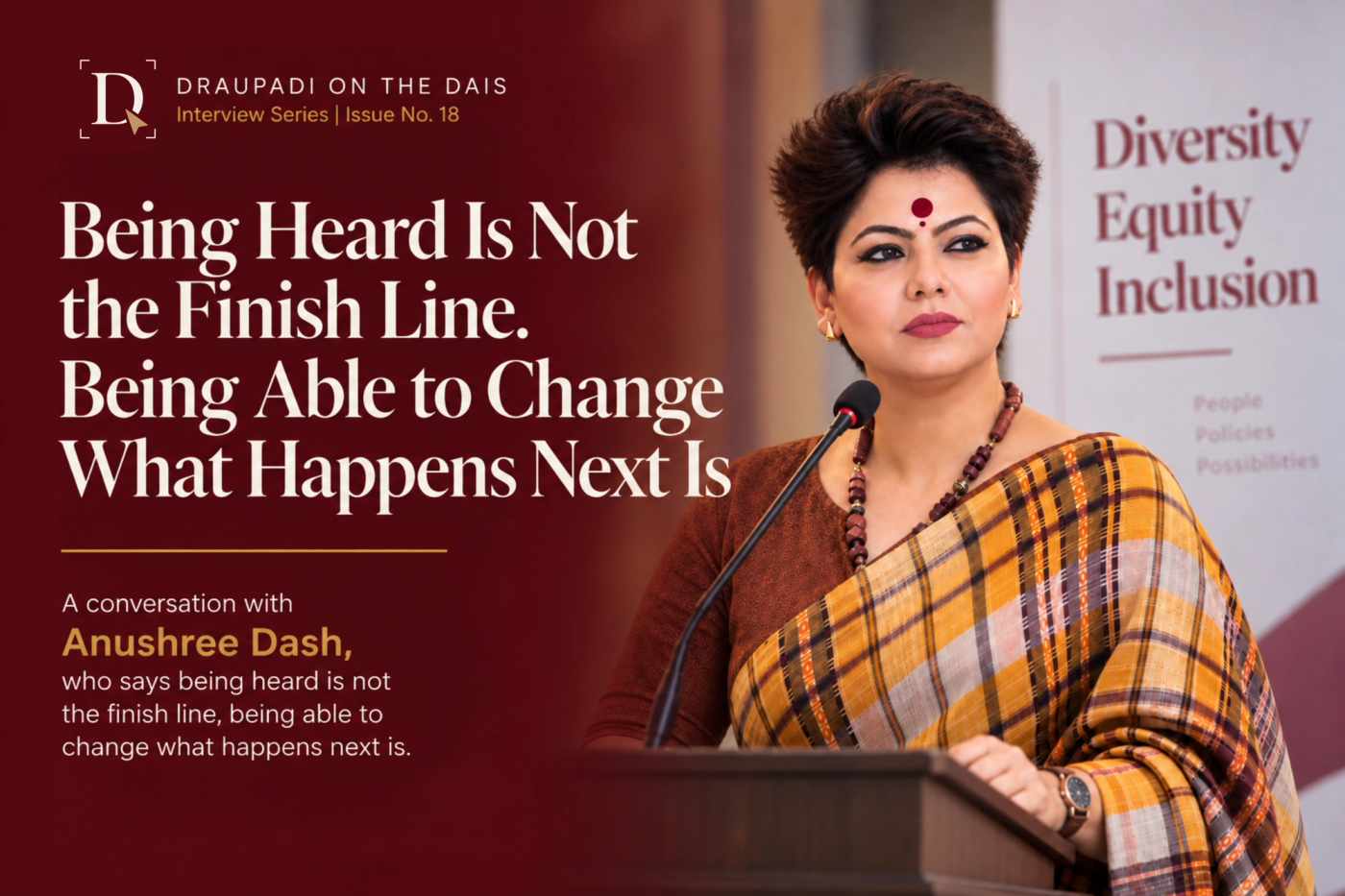
Being Heard Is Not the Finish Line. Being Able to Change What Happens Next Is
Anushree Dash is the Founder and Chairperson of ADiBha She Vision and Founder of ADiBha, working on social advocacy and women's leadership at the grassroots. She holds national and global advocacy roles including India Country Chair for Equity & Equality at G100: Mission Million and is a UN REX Karmaveer Global Fellow.
She is a Gender Equality Advocate, Human Rights Activist, social entrepreneur, and policy influencer working to move women’s empowerment from conversation to decision-making.
As the Founder & Chairperson of ADiBha She Vision, she leads grassroots and policy-driven interventions advancing women’s leadership, menstrual health and dignity, girls’ education, child protection, livelihoods, and equal representation in governance. She is also the Founder of ADiBha, a social enterprise creating sustainable pathways for women to build agency, opportunity, and economic independence.
A three-time TEDx Speaker, G20 Speaker, and G100 India Country Chair for Equity & Equality, she has represented India on national and global platforms, including the United Nations and Women Economic Forum, advocating for gender justice, inclusive development, and women’s meaningful participation in decision-making.
Her work has earned her recognition as a Karmaveer Chakra Awardee, alongside fellowships including Ananta, Aspire Circle, UN SheLeads, UN Women AI School, REX, and ISD.
From the grassroots to global platforms, she continues to turn lived realities into advocacy, advocacy into policy conversations, and policy conversations into action while inspiring a new generation of women to lead with dignity, equality, and purpose.
Leadership Belongs to Them Too
Q1. You are known for social advocacy and women's empowerment leadership. But there is often a project underneath the project, something you are building that does not have a job title attached to it. What is it?
The project underneath everything I do is deeply personal. My own journey has taught me that leadership is not something you are given. It is something you grow into, often by finding your voice when no one is waiting to hear it.
Coming from the grassroots and working closely with women and girls, I've seen how much potential exists when people are given dignity, confidence, and an opportunity to lead. That experience has shaped my vision to build spaces where women don't have to seek permission to lead, and where the next generation can start from a place of possibility, not limitation.
Through every initiative, conversation, and campaign, I'm really building something bigger, a culture where girls grow up knowing their voice matters, their choices matter, and leadership belongs to them too.
There may not be a job title for that. But for me, that is the work.
Impact Begins With Listening
Q2. Most careers have a decision that looked wrong from the outside and turned out to be exactly right. What was yours, and what did it teach you that no formal experience could have?
One of the decisions that looked most unexpected from the outside was walking away from a successful corporate career and the comfort of bigger cities to build a non-profit and work at the grassroots.
On paper, it looked like I was stepping away from growth. In reality, I was moving closer to purpose.
Working directly with women, girls and communities taught me something no corporate role could have taught me: impact begins with listening. You cannot design meaningful change from a distance. You have to sit with people, understand what dignity means in their everyday lives, and build solutions with them, not simply for them.
That decision changed my definition of success. It taught me that a meaningful career is not always about how far you can go. Sometimes, it is about how deeply you are willing to go.
I Would Rather Let the Work Speak
Q3. There is a version of visibility that requires performance, constant output, constant presence. And there is another version that is just being findable in the right places. How do you think about the difference?
I have never believed that visibility means being everywhere, all the time. For me, visibility has to have a purpose.
As an advocate, I want to be findable where the conversations that shape women's lives are happening, like at the grassroots, in institutions, in policy spaces, and increasingly in rooms where decisions are being made.
Consistent work creates credibility. I would rather let the work speak, and show up with intention when my voice can add something meaningful. I would rather build something substantial than manufacture noise around it.
Especially for women, I think visibility should not become another form of labour we have to constantly perform. We don't need to be everywhere. We need to be present where our presence can move the conversation forward.
Feathers Were Never the Point. Change Was
Q4. Panels often default to the same names, not out of malice but because the search is narrow. Have you ever been the default, and have you ever been outside it? What was different about each experience?
I have been both, the person people call when they want a strong voice on women's leadership and the person left outside the usual circle because my voice doesn't always make a room comfortable. But honestly, I've never built my work around being the "default name."
I don't follow the crowd, and I don't speak to please a room. I speak where I have something to say and I'm comfortable challenging what everyone else has decided is normal. I've challenged conversations around women's leadership, questioned who gets access to opportunities, and spoken openly about the systems that keep women out of decision-making spaces. That can make you visible to some rooms and unwelcome in others.
That comes with a cost. Women who refuse to soften their opinions, dilute their ambition, or make themselves more "likeable" are often perceived as difficult, intimidating, or even a threat. I've experienced that distance too. But I've never believed that being palatable is the price of being heard.
When I'm invited into a room, I want to bring a perspective, not simply occupy a chair. And when I'm outside the usual circle, I take that as a reminder that visibility should not be about fitting into the existing list.
Sometimes My Job Is to Make the Room Think
Q5. There is a particular way ambitious women in India are expected to be visible: enough that people notice, not so much that people are uncomfortable. How have you navigated that?
There is a very Indian version of the "ambitious woman" rule: be visible, but not too visible. Speak confidently, but don't sound intimidating. Have opinions, but preferably ones that everyone can politely agree with over chai.
I've never been particularly good at following that script.
Whether I'm in public spaces, advocacy circles, political conversations or working at the grassroots, I've learnt that the moment a woman starts asking uncomfortable questions, challenging the norm, or refusing to nod along, people suddenly become very concerned about her "tone."
Apparently, ambition is acceptable as long as it comes with good manners, a soft voice and preferably some namaste.
I chose a different route. I don't believe my job is to make every room comfortable. Sometimes my job is to make the room think. I will challenge, disagree and ask the question that everyone is thinking but nobody wants to ask.
And yes, that can make you "too outspoken," "too ambitious," or "difficult." I am okay with that. Because I'm not trying to be the woman everyone finds likeable. I'm trying to be the woman who makes it harder for the next woman to be told she is asking for too much. And if that ruffles a few feathers well, feathers were never the point. Change was.
I Have Something Bigger to Do Than Be Afraid
Q6. There is usually one fear that women at your level have learned to perform confidence around. They are good enough at the work that it does not show anymore. What is yours?
I've learned that fear can sit in the room but it doesn't get to make my decisions.
There was a time when I wondered whether I was ready for the rooms I was walking into. Today, I walk in knowing that I may not have every answer, but I have earned the right to ask difficult questions and take up space.
I have walked away from a successful corporate career, built a non-profit from the grassroots, spoken on stages, challenged systems, and stepped into public, advocacy and policy spaces where women are still often expected to prove themselves twice.
The fear of not being enough hasn't magically disappeared. I've simply stopped negotiating with it.
I have learned to walk into rooms without waiting for validation, disagree without becoming defensive, and be diplomatic without becoming diluted. I can respect the room without surrendering my voice to it. And honestly, I've stopped trying to look fearless. I'd rather be the woman who feels the fear, checks her lipstick, walks into the room anyway and says what needs to be said.
Because confidence, for me, is not "I have nothing to fear." It is: "I have something bigger to do than be afraid."
Being Heard Is Not the Finish Line
Q7. If you could change one thing about how your field identifies, develops, or elevates expertise, what would it be?
I would change one thing: stop mistaking women's presence for women's power.
Whether it is politics, policymaking, entrepreneurship, education, leadership or diplomacy, I don't want women invited into rooms as the token woman, the diversity statistic, or the person who gets three minutes to "share her perspective." I want her expertise to shape the decision, influence the policy, move the resources, and survive the meeting.
And women have a role in changing this too. We need to stop negotiating our values for access. Being strategic is important; becoming palatable is not. I would rather lose a seat than lose the reason I walked into the room.
And we need more allies, not the kind who clap for women when the room is easy, but the kind who share power, open doors, challenge bias, and stand beside a woman when her position becomes inconvenient. Because being heard is not the finish line. Being able to change what happens next is.
I'm not interested in putting more women at the table just so they can be heard. I want women at the table with the authority to decide and the courage to make those decisions count.
Anushree Dash is the Founder and Chairperson of ADiBha She Vision. This interview was conducted as part of the Draupadi on the Dais Interview Series.