You Need to Be Somewhere Meaningful, and Have Something Worth Finding
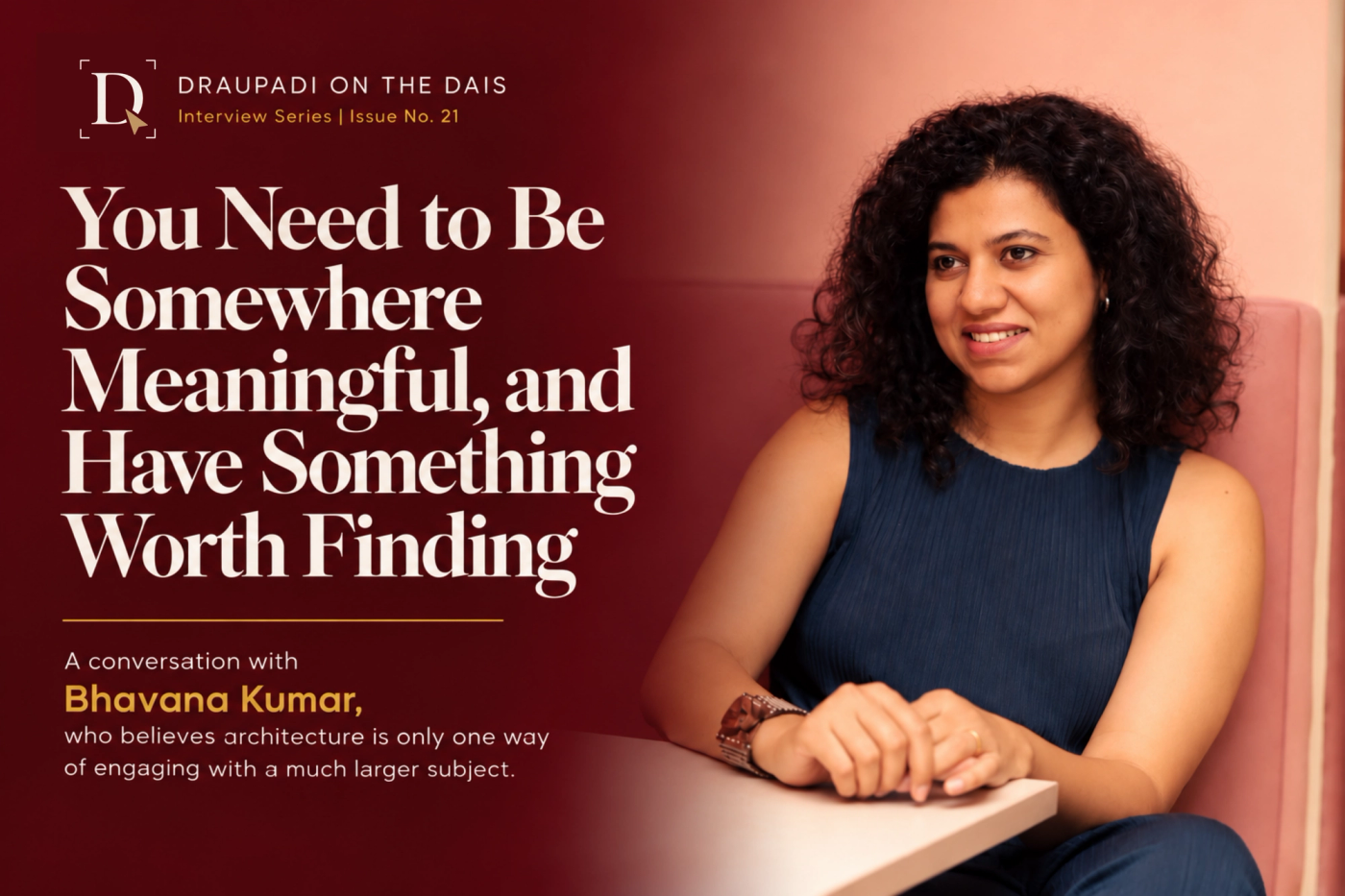
You Need to Be Somewhere Meaningful, and Have Something Worth Finding
Bhavana Kumar is Co-Founder and Principal Architect at Kumar La Noce, an architecture studio practising across India and Italy.
What Is Worth Making In The First Place
Q1. When did the work start feeling like yours, not just something you were doing?
From the very beginning, actually. I never really thought of myself as someone who was just doing a job, or that the work existed separately from me and my ability to shape it.
Even very early on, I felt quite strongly that I could have an impact on the work, that I could question it, change it, push it in a different direction. I didn't always know what the answer was, but I never doubted that I had a role in finding it.
What has changed over time is not that the work became mine, but that my understanding of what I want to do with that agency has become clearer.
Today I am less interested in proving that I can make something, and more interested in asking what is worth making in the first place.
Keeping the Thinking Coherent All the Way Through
Q2. There is usually work that happens with no name on it, no metric attached, and that most people around you probably do not notice. What is the most important thing you do that fits that description?
I think a large part of my job is holding on to the core intention behind a project.
There are hundreds of decisions between the first idea and the finished project, and it is very easy for that intention to get diluted along the way. So I spend a lot of time making sure we are asking the right questions, taking patient steps towards finding answers, and being willing to course-correct along the way.
The point is to make sure there is still a clear reason behind the decisions we are making.
It is not particularly visible work. But I think that is where a lot of the value of a design practice lies. The finished project is only the visible part. The real work is keeping the thinking coherent all the way through.
A Messy but Exciting Giant Tabletop
Q3. You are known for architecture across India and Italy, but there is often a project underneath the project, something you are building that does not have a job title attached to it. What is it?
Even before we were Kumar La Noce, for Nicola and me, architecture has been a medium for testing ideas collaboratively.
That has continued through the practice. I like that something we learn in one project can unexpectedly inform another. A material experiment can become a product. A house can become an enquiry into domesticity. The past, the present and the future are constantly clashing in our explorations and trying to form new ways of expression.
I am interested in what happens when knowledge doesn't stay trapped inside defined projects.
So the project underneath the projects is really a messy but exciting giant tabletop that is constantly evolving, a place where ideas accumulate, connect, collide and keep opening up new questions.
The Building Is Only One Way of Engaging With the Subject
Q4. What is the most widely held belief in your field that you quietly, or not so quietly, disagree with?
That architecture is primarily about the object.
I think we have become very focused on the building as the end product of architecture. The thing that gets photographed, published and judged.
Architecture as a subject, encompasses how and why we construct, inhabit, organise, adapt and understand space. It has a history, a body of knowledge, technologies, social and environmental contexts, and an enormous capacity for enquiry.
The building or the project is only one way of engaging with the subject.
Being Visible and Being Relevant
Q5. There is a version of visibility that requires performance, constant output, constant presence. And there is another version that is just being findable in the right places. How do you think about the difference?
I think there is a difference between being visible and being relevant.
I don't believe in constantly putting yourself or your work out there simply to stay visible. For me, visibility has value when it creates the opportunity for the right conversation; when someone encounters the work and understands something of what you are interested in, and that leads somewhere.
So I think being findable is important, but it should be a consequence of having a clear body of work and a point of view, rather than a constant performance of one.
You don't need to be everywhere. You need to be somewhere meaningful, and to have something worth finding.
Learning to Hold Your Ground Without Becoming Rigid
Q6. Building a career in India, in the field you are in, carries a specific set of invisible requirements that are not in any job description. What are some of them?
You have to learn to hold your ground without becoming rigid.
There is a constant negotiation between what you believe is good work and what is possible, between ambition and resources, between patience and the pressure to keep moving. You have to be able to navigate people, systems and circumstances that are often unpredictable, without losing sight of what you are trying to do.
You also need a certain resourcefulness. In India, constraints are often part of the brief, whether you asked for them or not. Learning to work with what is available, and sometimes finding opportunity in those constraints, is a big part of practising here.
And then there is resilience. Architecture is a long game. You can spend years developing an idea before you see it realised, and even then, the outcome is rarely entirely in your control.
As a woman, and particularly in construction, there is another layer to this. You learn to establish authority in environments where it is not always automatically given to you. You learn when to push, when to listen, and when to simply be very clear about what you know.
Perhaps the most important requirement, though, is staying curious enough to keep questioning the conditions you are working within, rather than simply learning to operate within them.
That We Went Deeper
Q7. Five years from now, you are in a conversation with someone whose judgment you trust. Not a performance review, just an honest conversation. What do you want to be able to say about this period?
That we went deeper.
Everything is changing very quickly. AI, climate change, technology, the way we live and work. There is a natural temptation, particularly in a creative field, to keep chasing what is new.
But I think the opposite is necessary. The faster things change, the more important it becomes to go back to the fundamentals.
Why are we doing this? Who is it for? What does it need to do? What should endure?
I want the next five years to be about asking better questions, becoming more precise about what we are trying to do, and finding more ambitious ways of acting on those questions.
Bhavana Kumar is Co-Founder and Principal Architect at Kumar La Noce. This interview was conducted as part of the Draupadi on the Dais Interview Series.