Keeping Your Abilities Tucked Away in a Treasure Box Doesn't Help Someone Discover Them
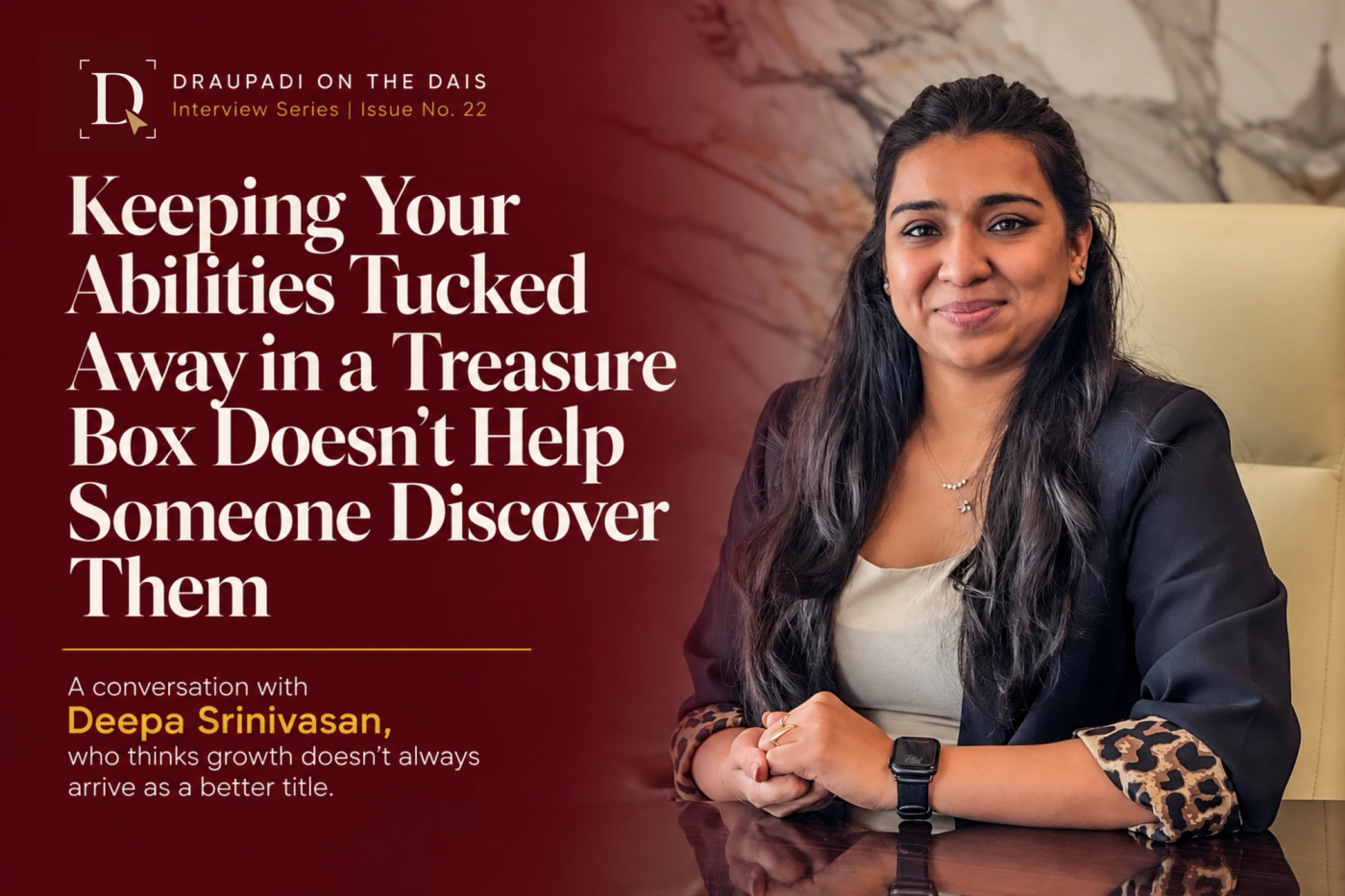
Keeping Your Abilities Tucked Away in a Treasure Box Doesn't Help Someone Discover Them
Deepa Srinivasan is a designer, and the creator of Rudh, her own design journal and creative studio.
That Is Truly When It Felt Like the Work Was Mine
Q1. When did the work start feeling like yours, not just something you were doing?
I work in interior design, a creative profession where you can be confident about a decision and still question whether you are good enough to make it; in short, an abundance of imposter syndrome-inducing opportunities at every step.
The shift happened when my recommendations began to be trusted because of the expertise behind them. I didn't need every idea to be accepted, but I needed my judgment to carry weight. Whether that came with seniority or the trust I had built with management, it gave me confidence I hadn't realised I was missing.
I started taking ownership beyond the immediate task, thinking about the outcome, anticipating problems and caring about what happened after the design was approved. Going the extra mile became exciting.
That experience also shaped how I think about leadership. Giving someone responsibility means very little if you never give them room to exercise their judgment. That is truly when it felt like the work was mine, the projects were mine, and so were the responsibilities and accountabilities for these.
Growth Doesn't Always Arrive as a Better Title
Q2. Most careers have a decision that looked wrong from the outside and turned out to be exactly right. What was yours, and what did it teach you that no formal experience could have?
For me, it was choosing to expand beyond a conventional design role when I joined a small family office.
A smaller organisation may not look like the obvious route to career growth. But it gave me exposure to the decisions surrounding design: budgets, procurement, contractors, timelines, and the commercial consequences of what we proposed.
It taught me to understand a project from the perspective of the person investing in it, the people executing it, and the people eventually using it. That changed the way I design and manage projects.
The biggest lesson was that growth doesn't always arrive as a better title. Sometimes it comes through a wider scope and the willingness to take responsibility before you feel completely ready.
A Quaint Little Studio, Built Online
Q3. You are known for design and project management, but there is often a project underneath the project, something you are building that does not have a job title attached to it. What is it?
I am building Rudh, my creative alter ego, my design journal. Rudh can be imagined as my quaint little studio, built online where one can walk in and see all my quirky interests and a peek into my artistic side of life.
Working in design means spending a lot of time interpreting other people's visions. I enjoy that, but I also want somewhere to explore my own curiosity: objects, everyday problems, things I want to make and ideas that don't fit neatly into a client brief.
Rudh is where I give those ideas a chance instead of leaving them in a notebook. I am currently exploring creating merchandise specific for designers, delving into the ocean of AI to bring tools that can help designers (along with the gazillion tools that are already there) and marching into consulting for small scale projects in India and the UAE.
There is also something personal about building an identity beyond an employer or a designation. I want to know what I can create when I set the direction, break limitation and diversify new things that create kindle curiosity, take the risk and put my own name behind the work.
Having Women in the Profession Is a Starting Point
Q4. What is the most widely held belief in your field that you quietly, or not so quietly, disagree with?
"Interior design is a women-dominated field" is often said as though it settles the question of equal opportunity. I question what we actually mean by that. Because like all other fields of work, we still don't find many women at sites, as construction managers, or as the people controlling budgets, leading businesses and making the final decisions, in comparison.
I also disagree with the explanation that women are naturally better at aesthetics or attention to detail. It sounds complimentary, but it reduces professional skills to gender traits. Design requires technical knowledge, commercial judgment, negotiation and leadership, too.
For me, equality means being trusted with authority, being paid fairly and having access to significant projects. It also means being able to be direct without that becoming a discussion about your personality.
Having women in the profession is a starting point. Having their ability to influence its direction is the more meaningful measure.
These Are Two Different Aspects of Visibility
Q5. There is a version of visibility that requires performance, constant output, constant presence. And there is another version that is just being findable in the right places. What do you think about the difference?
For me, these are two different aspects of visibility, and I believe they should coexist. Consistent effort and output build credibility, while being findable in the right places helps that work reach people who can recognise its value and create opportunities. Also meaning that one's work has reached its right audience and channels the right responses.
I want to be intentional about both: doing work I am proud of and placing myself in places with like minded people driven towards a similar goal to be appreciated and remembered for the right opportunities.
For women especially, there should be more than one way to achieve that visibility. We should be able to build a strong professional presence without constant public performance becoming another unpaid responsibility or a condition for being taken seriously.
Keeping Your Abilities Tucked Away in a Treasure Box
Q6. Have you ever watched someone with a thinner CV get called into a room you should have been in? What did that teach you about how discovery actually works?
More often than I would like to admit.
My first reaction is usually frustration, followed by some honest reflection. What made them a better fit? Was it a relationship, a clearer point of view, or simply that they had expressed interest while I assumed my work would speak for itself?
I have learnt that experience matters, but people also need to understand how that experience is relevant to them. Keeping your abilities tucked away in a treasure box doesn't help someone discover them.
At the same time, I don't think every missed opportunity should become an exercise in finding fault with ourselves. This brings a retrospection if the opportunity presented is the right one for me, given my involvement and my expression of interest. Sometimes, a missed opportunity is also a chance to rethink our own evolution and the space to look beyond our current circle.
A Full-Time Aunt, Currently
Q7. Right now, not in your bio but in your actual life, who are you across the different things you are doing?
A full-time aunt, currently. Everything else has taken a slight back seat because my life is being managed by a nine-month-old.
He has become my muse and brought back a creative spark that feels very personal. I keep wanting to make things for him by hand, and that has reminded me how much I enjoy creating without a brief, an approval process or a commercial outcome, which is not a toothless grin.
I am still a designer, a project manager and someone with plenty of ambitions. Right now, I am also enjoying being an aunt and making room for ideas I didn't have time to explore before.
I want women to have that freedom, to decide what deserves their attention at different points in life, without every change of pace being read as a loss of ambition.
Deepa Srinivasan is a designer and project manager, and the creator of Rudh. This interview was conducted as part of the Draupadi on the Dais Interview Series.