A Detour Is Not Always a Failure
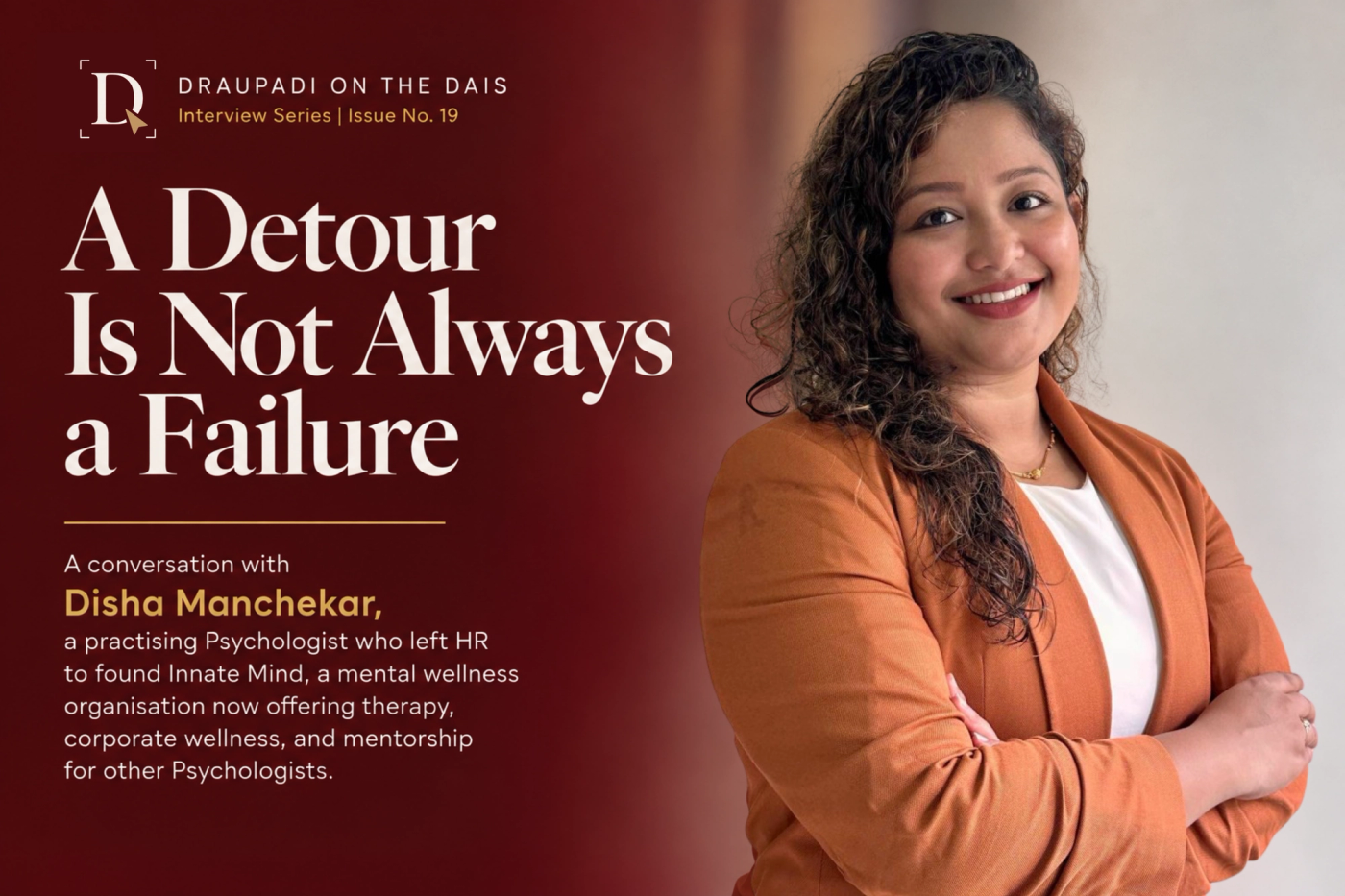
A Detour Is Not Always a Failure
Disha Manchekar is a practising Psychologist and the founder of Innate Mind, a mental wellness organisation offering therapy, corporate mental wellness services, and professional development mentorship for Psychologists. She has practised as a Psychologist for eight years and has run Innate Mind for five.
A Detour Is Not Always a Failure
Q1. Most careers have a decision that looked wrong from the outside and turned out to be exactly right. What was yours, and what did it teach you that no formal experience could have?
Pursuing Psychology after quitting HR and eventually starting Innate Mind was probably that decision.
Initially, I was questioned about why I was pursuing this path when I could pursue a more conventional, safer and predictable path. But I did it anyway to follow my calling.
After gaining some years of experience, I started to build Innate Mind. I chose to create a mental wellness organisation that was not only ethical but also provided quality services that provided lasting solutions.
What I didn't realise then was that entrepreneurship would teach me lessons that none of my academic training or psychology alone could. I learnt to dream, brainstorm, take calculated risks, understand the business behind meaningful work and evolve without losing the reason I started.
Over eight years as a practising Psychologist and five years running Innate Mind, I have realised that a detour is not always a failure. It can be an opportunity to live your dreams and make a difference to the lives of others.
An Intentional Value to Our Offerings
Q2. You are known for psychology and mental wellness, but there is often a project underneath the project, something you are building that does not have a job title attached to it. What is it?
Innate Mind began with therapy, but over time we expanded to include corporate mental wellness and professional development mentorship for Psychologists. I soon realised that I did not want to make these like any other service offerings. But rather to attach an intentional value to our offerings.
I wanted to make an impactful difference not only within organisations, towards people seeking therapy, but also to the service providers, making them more confident and creating sustainable as well as thoughtful mental-health work.
This philosophy is quietly shaping almost everything we are building at Innate Mind.
Holding the Bigger Picture
Q3. There is usually work that happens with no name on it, no metric attached, and that most people around you probably do not notice. What is the most important thing you do that fits that description?
I think it is holding the bigger picture.
As a Psychologist and founder, a lot of my most important work is not visible. It is thinking about why we are doing something before deciding what we should do. It is noticing patterns in clients, the mental health profession, organisations and even within Innate Mind.
It is brainstorming an idea for a long time before turning it into reality. It is reviewing a conversation after it has happened. It is thinking about whether something is genuinely useful or simply looks good on paper.
And there is another kind of invisible work that comes with being a mental health professional: holding space for people while juggling personal life and the responsibilities of being a founder.
There may be no metric for that. But I think some of the most consequential work happens precisely in those spaces where nobody is watching you.
Visibility Has More to Do With Clarity Than Volume
Q4. There is a version of visibility that requires performance, constant output, constant presence. And there is another version that is just being findable in the right places. How do you think about the difference?
Over time, I have realised that visibility has more to do with clarity than volume and that being findable is more meaningful than it.
I believe that the right client should be able to find you and understand, fairly quickly, what you stand for, what you are good at and why your work matters.
For me that means being intentional about where I show up and what I say. I don't want to perform expertise. I want my honesty, ethics, values, ideas and work to create that visibility for me.
I also think this is particularly important for women. We are often taught to either stay modest or constantly prove ourselves. I am learning that there is another way: you can be visible without becoming performative, and you can take up space without losing your authenticity.
Allowing Your Work to Be Witnessed
Q5. Being on DotD is a professional decision, not a self-promotion exercise. What made you decide to show up for yourself here?
I think there is something important about allowing your work to be witnessed.
Eight years into the mental health field, I have built work that I am genuinely proud of. My journey has helped me evolve as a Psychologist, founder and even as a human.
Showing up on DotD feels like an opportunity to acknowledge this journey. I am also grateful to be listed alongside women who are doing remarkable work across different fields. Being a part of a platform that brings together accomplished women is meaningful to me. It is a reminder of how many different ways there are to build a meaningful career and create an impact.
For me, showing up here is less of a self-promotion and more about owning my professional journey with gratitude.
Rest Does Not Have to Be Earned
Q6. What does rest actually look like for you right now, not in theory but in practice?
Rest is not as glamorous as it is talked about on social media!
I have realised that it is learning to not fill every available hour simply because I can. It means keeping some hours of my day completely free from work. For instance, stepping away from my phone and laptop to watch something guilt-free or paint without making it content to share on social media.
I have also realised that sometimes I don't require another 'self-care activity' but quietness to simply be. Also, that rest does not have to be 'earned' after being productive or sick. You can rest when your mind and body need it.
You Carry an Innate Wisdom
Q7. Is there a woman earlier in her career who reminds you of yourself? Not her background but her instincts. What do you find yourself wanting to tell her?
Having worked with countless early-career women, I deeply recognise myself in them.
I relate to the ones who are observing, learning, and quietly preparing their career paths despite challenges. They may not always have an answer to how to proceed, may self-doubt and may also wait for others to validate their decisions.
I would like to tell them: 'You don't need to have everything figured out before you begin. You carry an innate wisdom. Trust it more than ever. Take chances. Make mistakes. Learn from them. Reassess your strategy. But never quit!'
Disha Manchekar is a practising Psychologist and the founder of Innate Mind. This interview was conducted as part of the Draupadi on the Dais Interview Series.