The Self-Defining Indian Woman
The Self-Defining Indian Woman
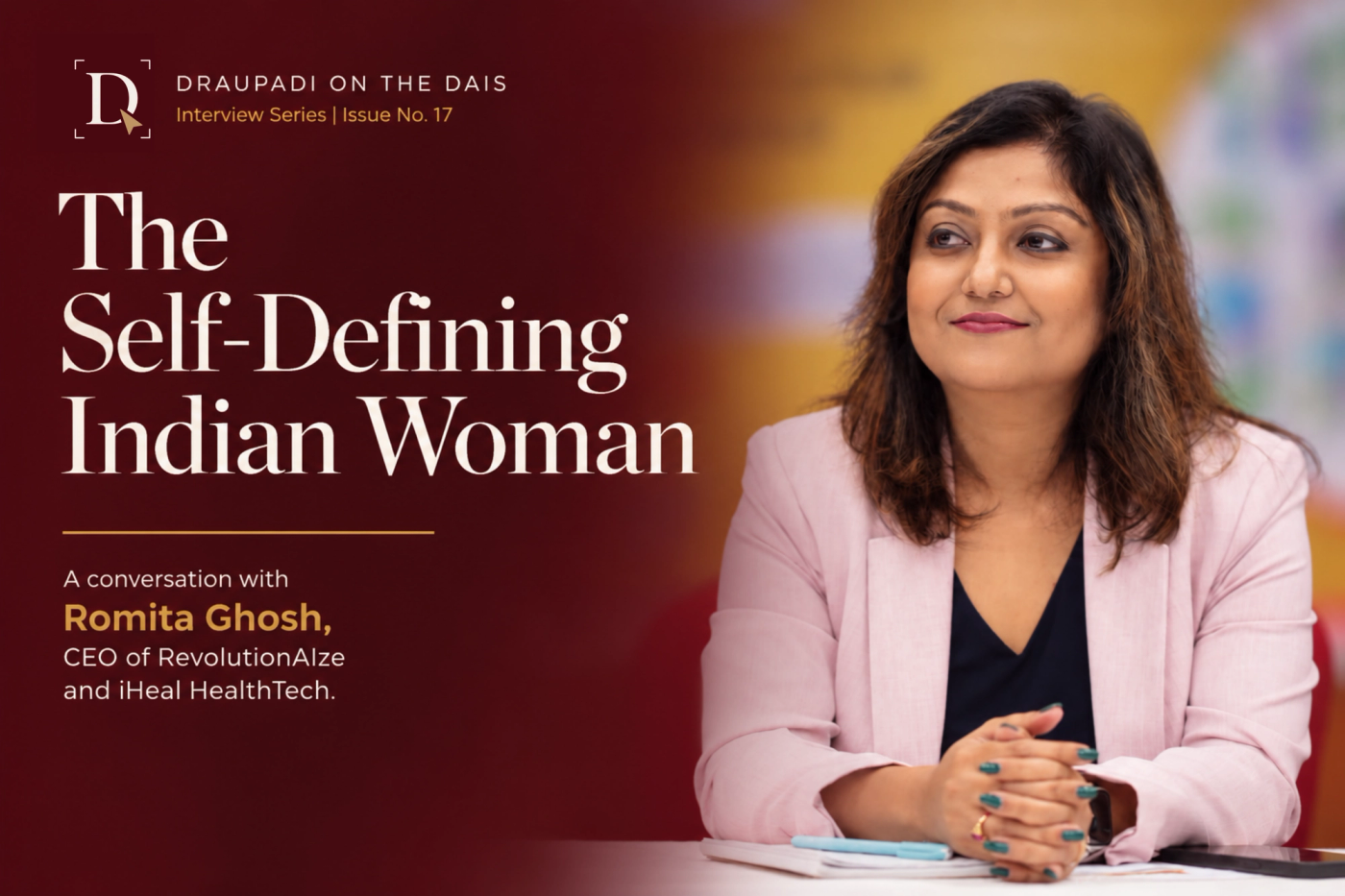
Romita Ghosh is the CEO of RevolutionAIze, where she leads MAAP, an AI-driven malnutrition detection and intervention tool recognised by the UN and WHO, and of iHeal HealthTech, spanning digital health, consumer wellness and the LOMO brand.
Reducing the Distance Between People and Possibility
Q1. You are known for AI-driven public health innovation and digital health entrepreneurship. But there is often a project underneath the project, something you are building that does not have a job title attached to it. What is it?
The project underneath all my projects is probably this: I am trying to reduce the distance between people and possibility.
Sometimes that takes the form of AI, sometimes public health, sometimes mentoring a girl who has never imagined herself in technology, and sometimes simply helping a system see someone it has historically overlooked.
I am interested in what happens when access changes. When a child is identified earlier. When a woman understands a technology rather than being intimidated by it. When a frontline worker has better information. When someone who was invisible in a dataset suddenly becomes visible in a decision.
So yes, I build companies and technologies. But the deeper work is about agency. I want people to have a better chance of participating in the systems that shape their lives, rather than being passive recipients of decisions made elsewhere.
A Very Intimate Relationship With Failure
Q2. Most careers have a decision that looked wrong from the outside and turned out to be exactly right. What was yours, and what did it teach you that no formal experience could have?
Leaving a more conventional corporate path and choosing entrepreneurship probably looked irrational to many people around me.
There is comfort in a title, a salary, and a predictable ladder. Entrepreneurship gives you none of that. It gives you uncertainty, responsibility, rejection, humiliation and a very intimate relationship with failure.
But it also taught me something no formal role could have: how to make decisions when there is no playbook. And how to live on my own terms with purpose at the core.
You learn to listen differently. You learn that a technically correct answer can still fail in the real world. You learn that people, timing, trust, cash flow, regulation, culture and execution can matter more than the elegance of an idea.
And you learn resilience in a very unromantic way. Not "never give up," but: know what to let go of, what to protect, and what is worth rebuilding.
That education has shaped almost everything I do today.
Visibility Is Partly About Responsibility
Q3. At some point in a woman's career, the question stops being "does she have what it takes" and starts being "can the right people find her." When did you notice that shift for yourself?
I noticed it when I realized I was no longer waiting to prove that I could do the work. I had already built things, led teams, worked across sectors, trained thousands of women and girls, and contributed to global policy and technology conversations.
But visibility does not automatically follow competence.
There are many women doing extraordinary work who are not in the obvious networks, not represented by the right institutions, and not the first names that come up when someone searches for an "expert."
That changed how I think about visibility. I used to see it almost as vanity. I no longer do.
If good work cannot be found, it often cannot influence the room where decisions are being made.
So today I think visibility is partly about responsibility. Not self-promotion for its own sake, but making sure that expertise from different geographies, disciplines and lived experiences actually enters the conversation.
What Can This Person Say That Almost Nobody Else Can
Q4. If you were briefing a conference organiser on how to actually find the best speaker for a topic rather than the most familiar one, what would you tell them?
I would say: stop beginning with the speaker list.
Begin with the question.
Ask yourself what the audience actually needs to understand, and then look for the person who has lived closest to that problem.
The best speaker may not be the person with the biggest title or the most polished online presence. It may be someone who has implemented the policy, worked in the field, built the technology, challenged the system, or dealt with the consequences when something failed.
I would also search outside the same institutional circles. Different countries, smaller organisations, practitioners, researchers, women who are not already overrepresented on panels, and people who can disagree intelligently.
And I would ask one simple question: What can this person say that almost nobody else in the room can say from direct experience?
That usually gets you closer to the right speaker.
The Self-Defining Indian Woman
Q5. Your field has a version of "the modern Indian woman" baked into how the work gets framed. What does that phrase get wrong, and what would you replace it with?
I think "the modern Indian woman" is too neat.
It suggests there is one direction of progress and one model of what an empowered woman should look like: educated, urban, financially independent, digitally fluent, professionally ambitious but not too ambitious, traditional but not too traditional.
But Indian women are not a category. Framing it in a bucket makes women who don't match that silhouette feel like they're running behind, when they were never running the same race. They are millions of very different realities.
A woman in a tribal community preserving food traditions, a scientist leading a lab, a caregiver managing three generations, an entrepreneur building a company, and a young girl learning to code can all be modern in completely different ways.
What matters to me is not whether a woman fits someone else's image of modernity.
It is whether she has agency.
Can she make meaningful choices? Can she access information? Can she participate economically and socially? Can she say no? Can she change direction? Can she imagine a future different from the one assigned to her?
I would replace "modern Indian woman" with something much less Instagrammable but much more authentic: "the self-defining Indian woman."
The Ability to Let Go
Q6. What does rest actually look like for you right now, not in theory but in practice?
Right now, rest for me looks very ordinary, and I think that is the point.
It is not always a holiday or switching off for three days. Sometimes it is choosing not to attend something, putting my phone away, having a slow coffee, reading without trying to turn it into "learning", taking a walk, travelling without packing the day with ten things, or simply leaving some space in my calendar.
I think I spent many years being very good at doing. Building, working, studying, travelling, saying yes to opportunities. Somewhere along the way, I started asking myself a different question: do I actually want to be present for all of this, or am I just afraid of missing something?
That became a personal shift for me. I started becoming more intentional about what deserves my energy and what I am completely happy to miss.
And strangely, that is also where the new idea of LOMO, Love of Missing Out, came from.
For me, LOMO is not about withdrawing from life. It is about choosing your life more carefully. Rest, recovery, self-care, saying no, doing less sometimes, these are all part of living fully.
So these days, rest looks like the ability to let go. And I am learning that sometimes the most intentional thing you can do is leave something out.
Less Energy Proving They Belong, More Energy Changing the System
Q7. You did not get here by accident. But the systems that help people find you often did not catch up with what you built. What would it mean for the next generation of women in your field if that changed?
For the next generation of women, better discovery systems could shorten years of unnecessary invisibility. Imagine if expertise were easier to find because their work, evidence and contribution were actually visible.
That would matter especially for women outside elite institutions, women in the Global South, women working across disciplines, and women whose careers do not follow a conventional linear path.
I would like the next generation to spend less energy proving they belong in the room and more energy changing the system. Because there is a huge difference between giving a deserving woman an audience before someone personally introducing them to one.
Romita Ghosh is the CEO of RevolutionAIze and iHeal HealthTech. This interview was conducted as part of the Draupadi on the Dais Interview Series.