True Strategic Foresight Requires Comfort With Isolation
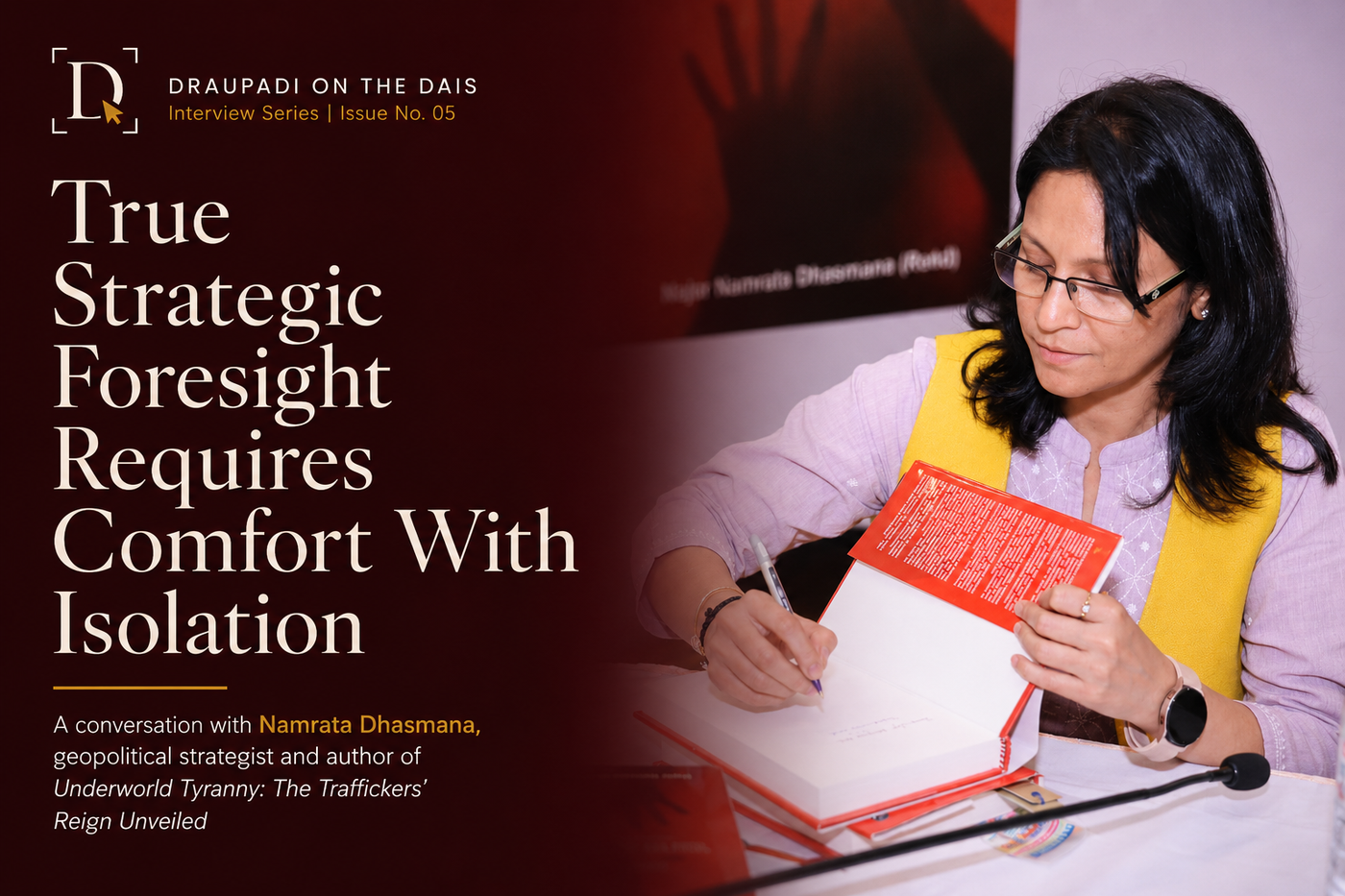
Namrata Dhasmana is not your conventional corporate strategist. She specializes in navigating the complex, high-stakes intersection of global macro-trends and long-range risk. A veteran, globally recognized thought leader, and author of Underworld Tyranny: The Traffickers’ Reign Unveiled, Namrata has pioneered an exemplary paradigm of leadership tailored for the Industry 5.0 framework of governance. As a strategist who refuses to chase transient noise, she balances sharp analytical precision with the rare leadership blend required to steer modern enterprises through macro-volatility and transformational global shifts.
Comfort With Isolation
Q1. Most careers have a decision that looked wrong from the outside and turned out to be exactly right. What was yours, and what did it teach you that no formal experience could have?
Choosing to step away from traditional corporate ladders to focus purely on niche geopolitical intelligence and long-range future risk assessment was that decision. From the outside, leaving structured, predictable leadership tracks looks like an unnecessary gamble. But formal corporate experience often teaches you how to optimize for the present quarter. What this move taught me, which no textbook could, is that entrepreneurship in a highly specialized field requires a foundational shift from executing existing frameworks to creating an entirely new ecosystem. True strategic foresight requires comfort with isolation. As an entrepreneur building a niche market from scratch, you have to be willing to look at data points that others dismiss as background noise, trust your analytical methodology, and wait for the horizon to catch up to your thesis. Ultimately, it taught me that creating value isn’t just about navigating an industry, it’s about pioneering the very ecosystem that sustains it.
Strategic Literacy
Q2. You are known for strategic and geopolitical intelligence, but there is often a project underneath the project, something you are building that does not have a job title attached to it. What is it?
I am dedicated to building strategic literacy. Beyond analysing conflicts or geopolitics, I want more people, especially young professionals and students, to focus on research to understand the underlying drivers behind any eventuality, think critically, question narratives, and understand how technology, economics, psychology, and national security intersect. If people leave my talks asking better questions than they had before, I consider that success. Research is the basis for any policy or innovation leading towards competitive advantage, and that is where my vision and my team’s collective execution align.
Our Work Serves an Explicit Executive Purpose
Q3. At some point in a woman's career, the question stops being whether she has what it takes and starts being whether the right people can find her. When did you notice that shift for yourself?
This is a niche field, and we work with an eye for detail, patience, and perseverance.
The real shift happens when you stop focusing on mass visibility and dedicate your energy entirely to delivering high-value strategic intelligence. I built this work with a clear vision: to provide actionable, Decision Intelligence.
I noticed this transition when opportunities began coming to us purely on the merit of our output. Instead of chasing leads, direct speaking invitations, collaborations, and strategic advisory requests started arriving from leadership teams and organizations who specifically needed our core capabilities.
Since we don’t do generic commentary, in the middle of all the noise, we remain structured and focused on our unique USP and offerings. Our work serves an explicit executive purpose, and when your work consistently delivers that level of clarity, the right business stakeholders will always find you.
Start With the Problem, Not the Name on the Poster
Q4. If you were briefing a conference organiser on how to actually find the best speaker for a topic rather than the most familiar one, what would you tell them?
I’d ask them to start with the problem they want solved, not the name they want on the poster. The best speaker isn’t always the most visible; it’s the person who has spent years thinking deeply about that specific issue. Look for original research, consistency of thought, and the ability to simplify complexity without oversimplifying it. Popularity can attract an audience, but expertise leaves the audience better informed.
Intellectual Credibility, Even When Your Threat Assessments Challenge Institutional Complacency
Q5. Building a career in India, in the field you are in, carries a specific set of invisible requirements that are not in any job description. What are some of them?
One invisible requirement is patience. Strategic intelligence isn’t a field where you find your footing overnight. Another is the ability to work across disciplines, today you cannot understand geopolitics without understanding technology, economics, AI, cyber, and information warfare. Finally, you need the courage to build an independent voice. In a rapidly evolving strategic environment, your greatest asset is intellectual credibility, even when your threat assessments challenge institutional complacency. Our global offerings deliver independent threat assessments and cross-disciplinary strategic intelligence to secure international business landscapes.
Creating Distance From Information
Q6. What does rest actually look like for you right now, not in theory but in practice?
For me, rest is creating distance from information. My work requires me to constantly monitor global events, so genuine rest means reading outside my field, spending time in nature, travelling, or simply having conversations that have nothing to do with geopolitics. Rest isn’t the absence of work; it’s giving my mind the space to reconnect with curiosity.
Recognising Interdisciplinary Strategic Thinkers
Q7. If you could change one thing about how your field identifies, develops, or elevates expertise, what would it be?
This field is uniquely positioned to capture immense international traction, drawing from global methodologies that successfully merge diverse domains. At CIF, we leverage curated strategic intelligence to navigate this complex landscape, actively aligning our capabilities with global standards. Recognizing that India currently lacks a dedicated, native Knowledge Firm capable of executing elite, sovereign analysis on that scale, we position ourselves to fill this critical structural gap. Today’s strategic challenges do not fit into rigid, traditional compartments. A Strategic Intelligence Practitioner must seamlessly integrate AI, cyber, economics, quantum technologies, intelligence, and defense. Evaluating capability through legacy labels limits broader potential. The industry demands a shift toward building a cohesive ecosystem focused entirely on interdisciplinary Strategic Intelligence.
Namrata Dhasmana is Founder and Director of EvoluTioon Strategic Group Private Limited, Chief Strategist at the Centre of International Futures, and Independent Director. This interview was conducted as part of the Draupadi on the Dais Interview Series.