You Have to Make Yourself Findable
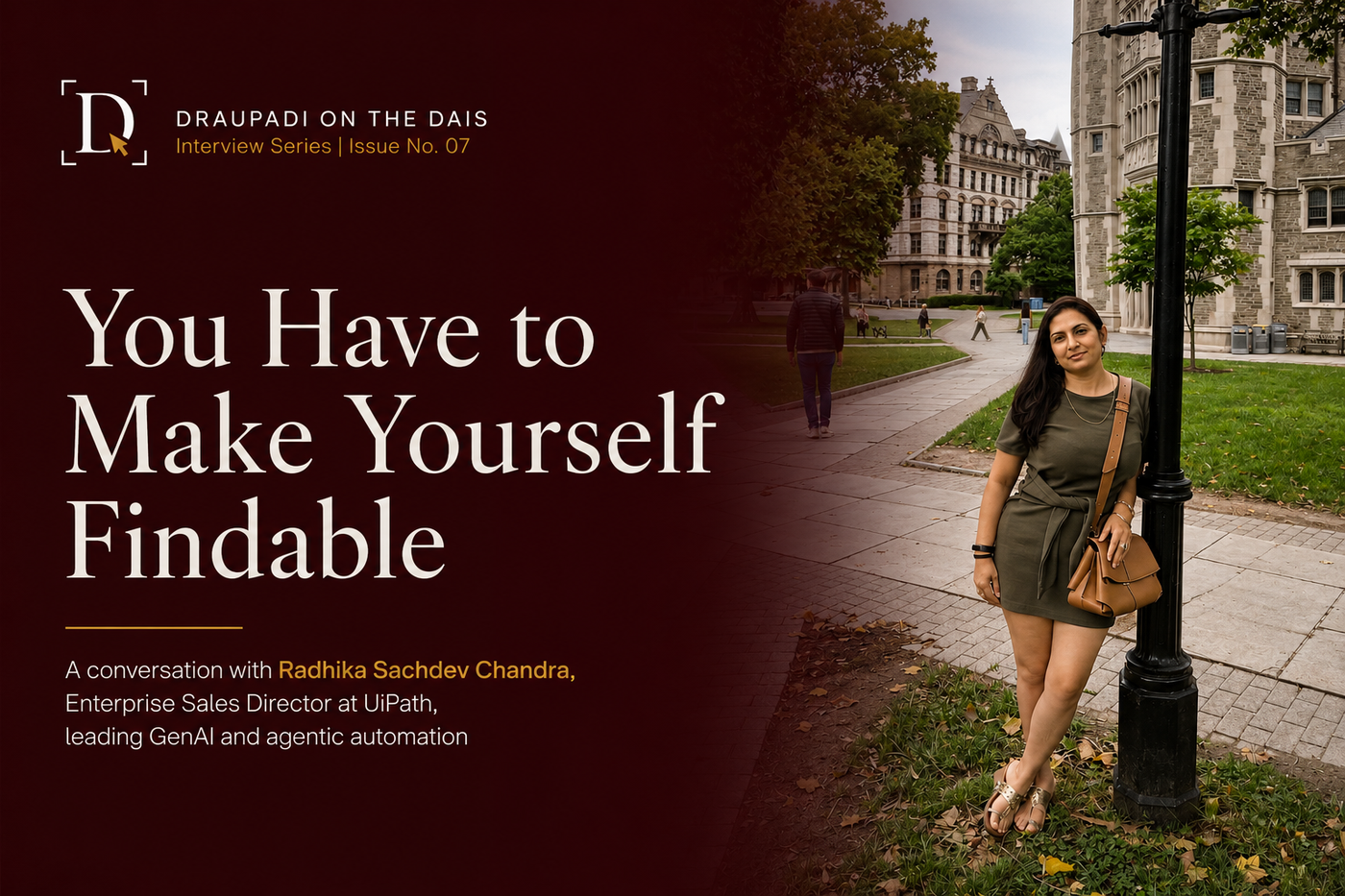
Radhika Sachdev Chandra is Enterprise Sales Director at UiPath, leading sales for GenAI and agentic automation. Her career spans over 20 years across senior sales leadership at Microsoft, Oracle, and Genpact, enterprise technology consulting at Headstrong, and software engineering at IBM and Tech Mahindra.
Informed Instinct
Q1. Most careers have a decision that looked wrong from the outside and turned out to be exactly right. What was yours, and what did it teach you that no formal experience could have?
Honestly, for me, the decisions that looked wrong from the outside usually had some element of risk, but they were never completely blind leaps. The choices that turned out well were the ones where I had at least some faith that I was moving in the right direction, even if the outcome was uncertain.
What that taught me is that instinct matters, but informed instinct matters more. No formal experience can fully teach you when to trust yourself, when to take a bet, and when to walk away from something that looks good on paper but does not feel right.
A Better Storyteller
Q2. You are known for enterprise sales in AI and automation, but there is often a project underneath the project, something you are building that does not have a job title attached to it. What is it?
I’m constantly evolving myself into a better storyteller. I use every sales opportunity to hone that skill.
Enterprise sales, especially in AI and automation, is not just about explaining a product. It is about helping people see a future state clearly enough to believe in it. That requires storytelling, empathy, structure, and timing.
One day, when I’m out of commercially viable MNC jobs, maybe I’ll turn fully to storytelling. Until then, I get to practise it every day.
The Ability to Listen and a Genuine Sense of Empathy
Q3. What is the most widely held belief in your field that you quietly, or not so quietly, disagree with?
That good salespeople have to be shrewd, cunning, or able to sell anything to anyone.
I openly disagree with that. Most good salespeople will tell you that the first attributes needed in sales are the ability to listen and a genuine sense of empathy. If you fundamentally do not care about the customer, you may win a transaction, but you will not build credibility.
Sales is not about forcing a need where none exists. It is about understanding the customer deeply enough to know whether you can actually help. Without that, you eventually fail.
You Have to Make Yourself Findable
Q4. Have you ever watched someone with a thinner CV get called into a room you should have been in? What did that teach you about how discovery actually works?
Yes, and I think that happens all the time, to people everywhere and I myself have learnt it the hard way.
What it taught me is that capability alone is not always enough. The people who get called into the room are often the ones who have done a better job articulating their value to the right audience.
Simply doing the work is not enough. You also have to take the time and care to curate a visible brand around the work. Discovery does not happen automatically. You have to make yourself findable.
One Earns Trust, the Other Creates Access
Q5. There is a version of visibility that requires performance, constant output, constant presence. And there is another version that is just being findable in the right places. How do you think about the difference?
To be genuinely successful, I think you need both.
Performance without visibility may not get you into bigger rooms. Visibility without performance may get you into the room, but you will eventually be shown the door.
To be invited in and to stay there, you need substance and discoverability. One earns trust; the other creates access.
Learn to Market Yourself Consistently and Intentionally
Q6. There is a kind of credibility that accumulates quietly, through work done over years, that still does not translate into the right invitations. Where do you think that gap lives?
The gap lives in visibility.
Invitations are often extended to people who have taken the time and effort to ensure that their credibility is routinely visible to the right people. Ten people knowing you at 60% of your capability can sometimes be more powerful than two people knowing you at 90%.
This gap can be especially evident for women. Many of us battle stronger impostor syndrome, try to match 98% of a job description before applying, hesitate to ask for what we want, and do not always trust our own worth enough to take risks.
It is not enough to be a strong performer. You also have to learn to market yourself consistently and intentionally.
The Paycheque Kept Getting Bigger
Q7. Five years from now, you are in a conversation with someone whose judgment you trust. Not a performance review, just an honest conversation. What do you want to be able to say about this period?
I would want to say that every decision and every job during this period made me a better version of myself.
I would want to say that I kept learning, kept growing, took the right risks, and did not have to compromise on my sense of ambition or self-worth.
And yes, I would also like to say that the paycheque kept getting bigger.
Radhika Sachdev Chandra is Enterprise Sales Director at UiPath. This interview was conducted as part of the Draupadi on the Dais Interview Series.