I Didn't Play Small When I Had the Opportunity to Build Something Bigger
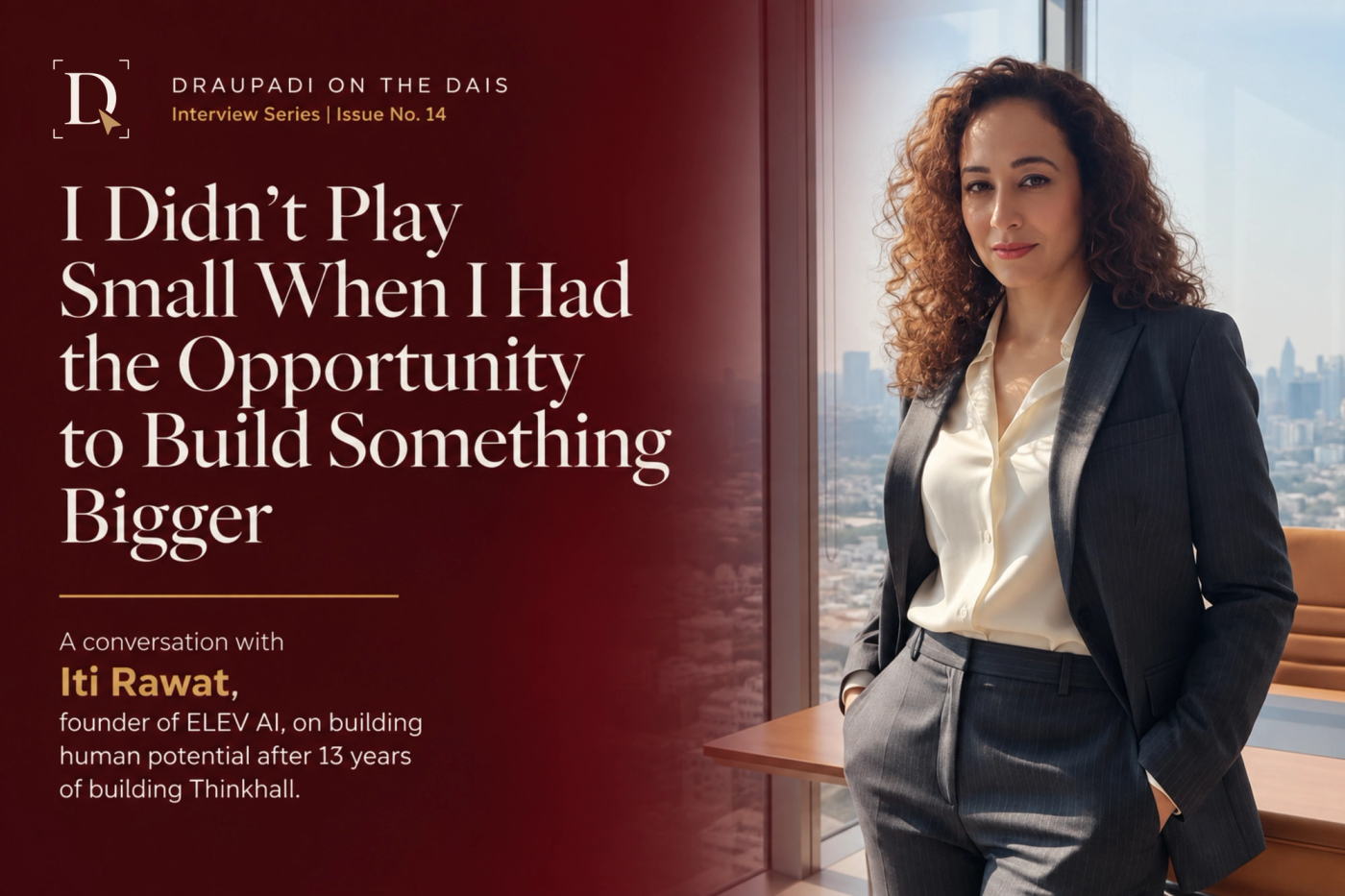
I Didn't Play Small When I Had the Opportunity to Build Something Bigger
Iti Rawat is the founder of ELEV AI, a technology company building talent intelligence for the future of work. She spent 13 years building Thinkhall, a skilling and capability-building firm, and founded WEFT, a network supporting women entrepreneurs, and the Red Dot Initiative, which supported women facing domestic violence during the pandemic.
There Is No Dashboard for That
Q1. There is usually work that happens with no name on it, no metric attached, and that most people around you probably do not notice. What is the most important thing you do that fits that description?
I think it is making people believe in themselves before they have evidence that they should.
A lot of my work over the years has been about building capability, whether through Thinkhall, through working with thousands of trainers, through WEFT and women entrepreneurs, or through the Red Dot Initiative, where we supported women facing domestic violence.
But the most important work often happens in the conversations nobody sees.
A woman calling because she doesn't know what to do next. A young professional doubting whether she is capable of taking the next step. A trainer who has spent years doing good work but has never learned how to make herself visible. An entrepreneur who needs someone to say, "You are not thinking too small. You have just been surrounded by people who made you think you should."
There is no dashboard for that.
You may never know what one conversation did for someone's life.
I have come to believe that empowerment is not always about rescuing someone. Sometimes it is simply helping them see that they have choices.
And once a person sees their choices, they become much harder to stop.
The Project Underneath Everything I Have Built Is Human Potential
Q2. You are known for skilling and talent intelligence, but there is often a project underneath the project, something you are building that does not have a job title attached to it. What is it?
I think the project underneath everything I have built is human potential.
Thinkhall started with training. Over 13 years, it evolved into understanding how people learn, how organisations develop capability, and why so much corporate training fails to translate into behaviour.
Now, with ELEV AI, we are building technology around that same question at a much larger scale: How do we help people become more capable, more relevant and more confident in a world that is changing faster than their job descriptions?
But there is another layer to it.
I have spent a large part of my life trying to create access - access to knowledge, access to opportunities, access to networks, access to confidence and, particularly for women, access to financial independence.
That is probably the invisible project running underneath my career.
I don't want to simply build another technology company.
I want to build systems that make human potential more visible and more usable.
Perhaps that is why the word ELEV resonates with me so much. We don't stop at what someone is today. We ask what they could become if the right intelligence, opportunity and support came together.
That is the project underneath the project.
Don't Search for a Famous Person. Search for Someone Who Has Lived the Problem
Q3. If you were briefing a conference organiser on how to actually find the best speaker for a topic rather than the most familiar one, what would you tell them?
I would tell them: don't search for a famous person. Search for someone who has lived the problem.
The best speaker is not necessarily the person with the biggest title, the largest following or the most photographs on stage.
Ask three questions.
Have they actually done the work? Have they thought deeply about it? And can they make an audience think differently when they leave the room?
I have been in rooms where the most senior person said very little and the person with the least impressive title changed the entire conversation.
A good speaker should bring a point of view, not just information.
And I would especially encourage conference organisers to look beyond the usual circle of names. There are extraordinary women, entrepreneurs, operators, researchers, creators and practitioners doing deeply interesting work who simply aren't part of the "usual speaker circuit."
Sometimes the most valuable voice on a panel is the one you had to look a little harder to find.
Representation should not be a checkbox. It should improve the conversation.
That is also why I believe initiatives like Draupadi on the Dais matter. The industry doesn't necessarily have a shortage of women with expertise. It has a visibility and discovery problem.
Credibility Is Accumulated Through Work. Visibility Is Accumulated Through Storytelling
Q4. There is a kind of credibility that accumulates quietly, through work done over years, that still does not translate into the right invitations. Where do you think that gap lives?
I think the gap lives between doing the work and being discoverable for the work.
Women are often taught to become good at what they do. We are less often taught to make sure the world knows what we have become good at.
I have experienced that myself.
You can spend 10 or 15 years building businesses, working with large organisations, solving real problems, building teams, creating intellectual property and helping other people grow, and yet the outside world may still know you only through one narrow label.
The ecosystem tends to reward visibility that is easy to understand.
But real careers are rarely that neat.
I have been a corporate professional, entrepreneur, trainer, speaker, women's empowerment advocate, community builder and now a technology founder. These may look like separate identities on paper. To me, they are chapters of the same story.
The answer isn't to become louder for the sake of being visible.
It is to become intentional about documenting your work, owning your point of view and building a body of evidence around what you know.
Credibility is accumulated through work. Visibility is accumulated through storytelling. Women need both.
Don't Be in Such a Hurry to Make Yourself Easier to Understand
Q5. Is there a woman earlier in her career who reminds you of yourself? Not her background but her instincts. What do you find yourself wanting to tell her?
I recognise myself in women who are curious, restless and slightly uncomfortable with the conventional definition of success. And yes, I have met not one, many women in their early career like that. There was one who was working closely with me in Thinkhall for Social Media, on a basic monthly retainership salary, now she has her own firm and is a founder herself.
We are the kind of women who are doing well but still think, There has to be something more.
Women who can see a problem nobody has asked her to solve yet.
Women who has multiple interests and is constantly told she needs to "focus" because the world is more comfortable when it can put you into one box.
I would tell her: don't be in such a hurry to make yourself easier to understand.
Your seemingly unrelated experiences may actually become your biggest advantage later.
I started in fashion and retail, moved through merchandising, buying, business development, retail expansion and operations, then entrepreneurship, learning, women-led initiatives and now technology and AI.
At different points, I probably looked like I was changing directions.
In hindsight, I was collecting perspectives.
So I would tell her: build your financial independence. Build your skills. Build your network. Take care of your body. Learn to negotiate. Learn to say no. And don't confuse being liked with being respected.
Most importantly, don't wait until you feel completely ready.
Some of the most important chapters of my life began when I was still figuring things out.
Surface Potential That Traditional Systems Miss
Q6. You did not get here by accident. But the systems that help people find you often did not catch up with what you built. What would it mean for the next generation of women in your field if that changed?
It would mean that women wouldn't have to work twice as hard just to become visible for the work they are already doing.
Imagine a world where the system could actually discover capability, not just credentials, designations or networks.
Where an excellent trainer from a smaller city could be found by a global organisation.
Where a woman entrepreneur's expertise could be discovered before she had built a massive personal brand.
Where a young woman could understand not just what job she can get today, but what skills she needs to build for the career she wants five years from now.
That is one of the reasons I am excited about what we are building at ELEV AI.
Technology should not only automate work. It should help surface potential that traditional systems miss.
And I think that is particularly powerful for women.
Because there are millions of women whose capability is greater than their visibility.
If we can build systems that recognise skills, potential, learning agility and capability more intelligently, we can start changing who gets seen, who gets opportunities and ultimately who gets to lead.
For me, that would be a much more meaningful definition of technology for the future of work.
I Am Allowed to Build Another
Q7. Five years from now, you are in a conversation with someone whose judgment you trust. Not a performance review, just an honest conversation. What do you want to be able to say about this period?
I want to be able to say, "I didn't play small when I had the opportunity to build something bigger."
This period is probably one of the most consequential chapters of my life.
After 13 years of building Thinkhall, I could have stayed with what was familiar. We had customers, revenue, relationships and a business that worked.
Instead, I chose to build again.
That is frightening when you are not 25 anymore.
But it is also liberating.
Five years from now, I don't want to measure this period only by valuation, revenue or the size of ELEV AI.
Of course, I want to build a significant company. I want ELEV to become a meaningful player in the future of work and to create opportunities for many people.
But I also want to look back and know that I stayed curious.
That I built something I genuinely believed needed to exist.
That I created opportunities for other people while creating one for myself.
That I used technology to elevate human potential rather than diminish it.
And perhaps most importantly, that my daughters saw their mother take a risk at 40-something and say:
"I have already built one chapter. I am allowed to build another."
If I can say that honestly five years from now, I think this period will have been worth everything.
Iti Rawat is the founder of ELEV AI. This interview was conducted as part of the Draupadi on the Dais Interview Series.