The World Can Only Find What You Allow It to See
The World Can Only Find What You Allow It to See
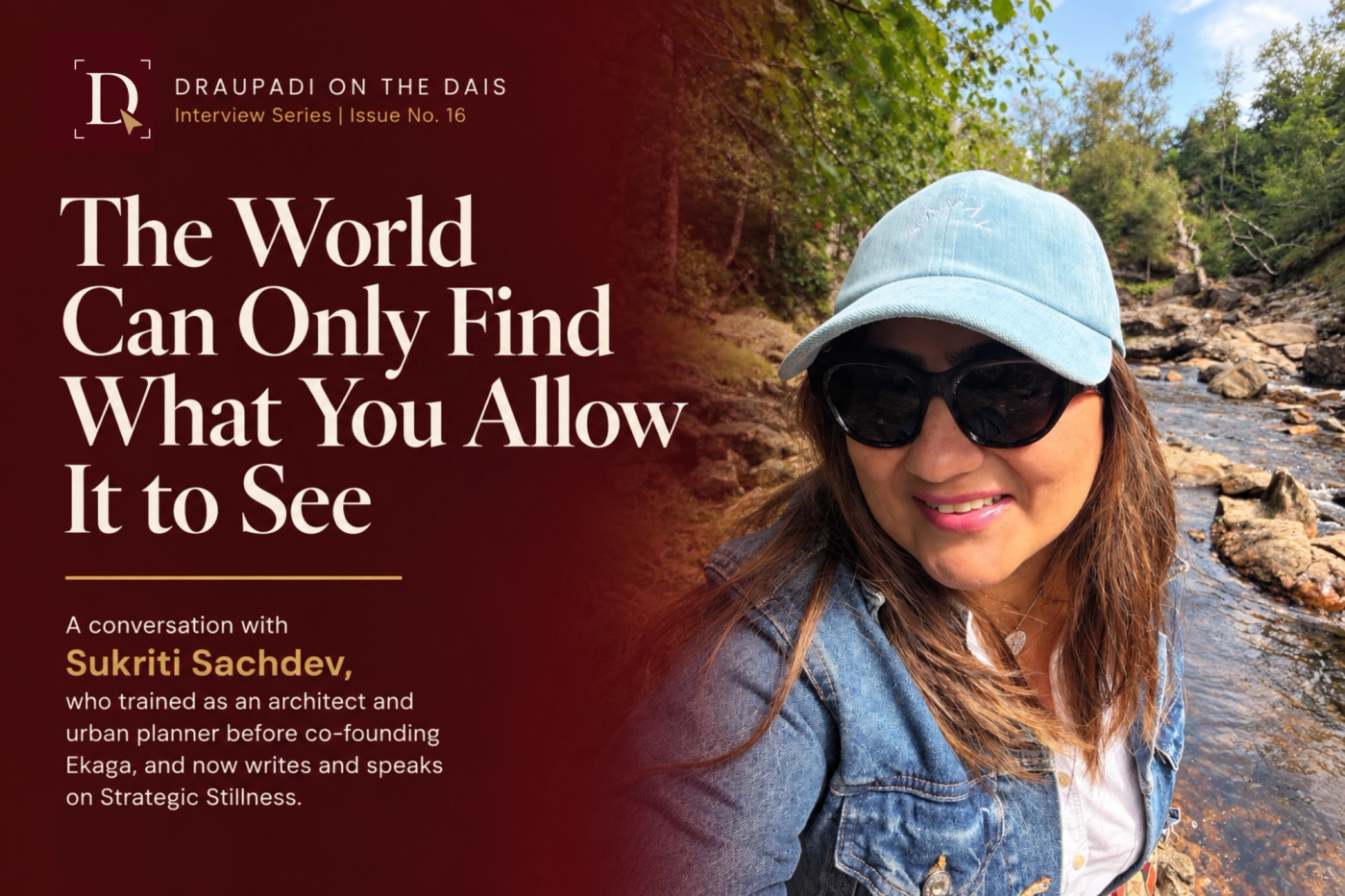
Sukriti Sachdev is Managing Partner at Ekaga Group, spanning Mumbai, Gurgaon and Dubai. She trained as an architect and urban planner before co-founding Ekaga, and now also writes and speaks on leadership, including her own thinking around Strategic Stillness.
I Have Quietly Learnt to Clap for Myself
Q1. There is usually work that happens with no name on it, no metric attached, and that most people around you probably do not notice. What is the most important thing you do that fits that description?
I love this question, because I think a lot of what we do goes unnoticed. And maybe it should. Not everything needs applause or a metric attached to it.
But I also think when you are putting in a hell of a lot of effort, there are moments when you want someone to notice, to clap for you, to give you that little "You go, Girl." And sometimes, nobody does.
I think one thing I have quietly learnt to do is to clap for myself.
Recently, during my programme at London Business School, I had one of those moments. We were given a tricky assignment with almost no preparation, and I had to stand up and speak in front of a room full of people. I had no strategy for how it would go and no outcome planned. So I simply decided to be myself.
And when I finished, I cheered. Loudly.
It was funny, but it also changed something in the room. Other people started cheering too. That moment stayed with me because sometimes things will not go the way you planned, and nobody may notice how much it took for you to get there. But you can still decide how you want to show up, in that very moment.
I think that is something I do that probably has no name or metric attached to it. I create my own encouragement, and very often, that gives other people permission to do the same.
You Don't Have to Know Everything Before You Enter a Room
Q2. Most careers have a decision that looked wrong from the outside and turned out to be exactly right. What was yours, and what did it teach you that no formal experience could have?
I wouldn't necessarily call it a decision that looked wrong. It was more a decision where even I sometimes thought, "I don't know if I can do this."
I have pivoted quite a bit in my career; from architecture to town planning, then entrepreneurship, and now into writing, speaking and developing ideas around leadership. But the biggest leap was definitely entrepreneurship.
When I entered the business, I knew practically nothing about telecom or technology. I just jumped in. I remember sitting in front of my screen for hours, searching what different terms meant. Walking into meetings sometimes felt like punishment because I would be sitting across the table thinking, "I have absolutely no idea how to respond to this." Even something like ROI felt foreign to me. I came from a world where, in my head, two plus two was four. Business didn't always work that way.
But I kept showing up. And more importantly, I kept asking questions.
Sometimes I would ask something and wonder if the person across the table was thinking, "Is she really the co-founder?" But I asked anyway. And over time, people around me became some of my greatest teachers. I learnt business by being in business.
That experience taught me something no formal qualification could have taught me; you don't have to know everything before you enter a room. You have to be willing to enter it, admit what you don't know, ask without embarrassment and learn.
I think that has stayed with me through every pivot since. Nothing is too small to ask, and no starting point is too small to grow from.
I Can Create a Space That Is Distinctly Mine
Q3. At some point in a woman's career, the question stops being "does she have what it takes" and starts being "can the right people find her." When did you notice that shift for yourself?
I think this question describes exactly where I am today.
For a long time, I was doing the work, building businesses, learning, changing, evolving, but perhaps there wasn't one clear answer to, "Who is Sukriti, and what does she stand for?" Today, I feel that has changed.
People are beginning to find me for what I bring to the table, rather than me constantly having to explain or prove what I can do. And there is something incredibly liberating about that. It feels like people can finally say, "There she is. We know what she brings. We know what to come to her for."
And I think that shift happened when I stopped trying to fit all the different parts of my career into a conventional box. I am an entrepreneur. I work across international markets. I write and speak about leadership. I am developing my own thinking around Strategic Stillness. Earlier, these might have felt like separate identities. Today, they feel like different expressions of the same person.
So when did I notice the shift, I would say, very recently! This is the present me.
And I genuinely want to dance when I think about it! Because after years of asking myself, "Where exactly do I fit?", I am reaching a stage where I don't need to fit somewhere. I can create a space that is distinctly mine.
Perhaps that is what being found really means. Not becoming more visible by becoming louder, but becoming clear enough that the right people know why they should find you.
Visibility Is Simply Not Hiding the Work
Q4. There is a kind of credibility that accumulates quietly, through work done over years, that still does not translate into the right invitations. Where do you think that gap lives?
I think the gap lives somewhere between doing good work and being visible for that work. For years, I believed that if you just keep doing your work well, eventually the right people will notice. But I have realised it doesn't always happen that way. Sometimes you have to step out, speak about what you know, share what you have learnt and allow people to discover you.
For me, that has been a learning in itself because visibility is not about shouting louder. It is simply about not hiding the work you have spent years building.
Getting Yourself Read Beyond What Is Written on Your CV
Q5. Building a career in India, in the field you are in, carries a specific set of invisible requirements that are not in any job description. What are some of them?
For me, one of those invisible requirements has been learning how to get yourself "read" beyond what is written on your CV.
I remember sitting in an interview at the beginning of my career, just after my masters degree, where knowing the regional language was almost a requirement for getting the job; and I didn't know it! On paper, that could have been the end of the conversation. But I learnt that sometimes you have to help people see beyond the missing box and understand the skills, experience and thinking you would bring to the table.
Over the years, I think that has stayed with me. Careers are not always built by perfectly fitting the requirements. Sometimes they are built by being able to walk into a room, own what you don't have, and make people see the value of what you do.
Rest Is Being With My People
Q6. What does rest actually look like for you right now, not in theory but in practice?
Rest for me is being with my people. Friends form a very important part of my life because that is where I find a different kind of peace.
Sometimes it is just a warm hug, sitting together over coffee, and having endless conversations that have absolutely nothing to do with work, goals or responsibilities.
Responsibilities will always be a part of life, and I take mine seriously. But I think endless fun should be a part of life too. So right now, rest for me is not necessarily doing nothing. It is being around people with whom I can simply be myself, laugh a little louder, talk a little longer, and forget the clock for a while.
The World Can Only Find What You Allow It to See
Q7. You did not get here by accident. But the systems that help people find you often did not catch up with what you built. What would it mean for the next generation of women in your field if that changed?
I don't necessarily see this only through the lens of being a woman. For me, it is more about making good work easier to discover. There are so many incredible people doing meaningful work quietly, but capability and visibility don't always grow at the same pace.
If that changes for the next generation of women, I hope they find the right rooms, the right people and the right opportunities a little earlier. Not because someone makes space for them, but because what they have built becomes easier to see.
And maybe I will end with something I truly believe, keep doing good work, but don't hide it too well. The world can only find what you allow it to see!
And when it finds you, just smile, take the invitation and walk into that room. You have earned it.
Sukriti Sachdev is Managing Partner at Ekaga Group. This interview was conducted as part of the Draupadi on the Dais Interview Series.