The First Group Is Everywhere. The Second Group Is Findable.
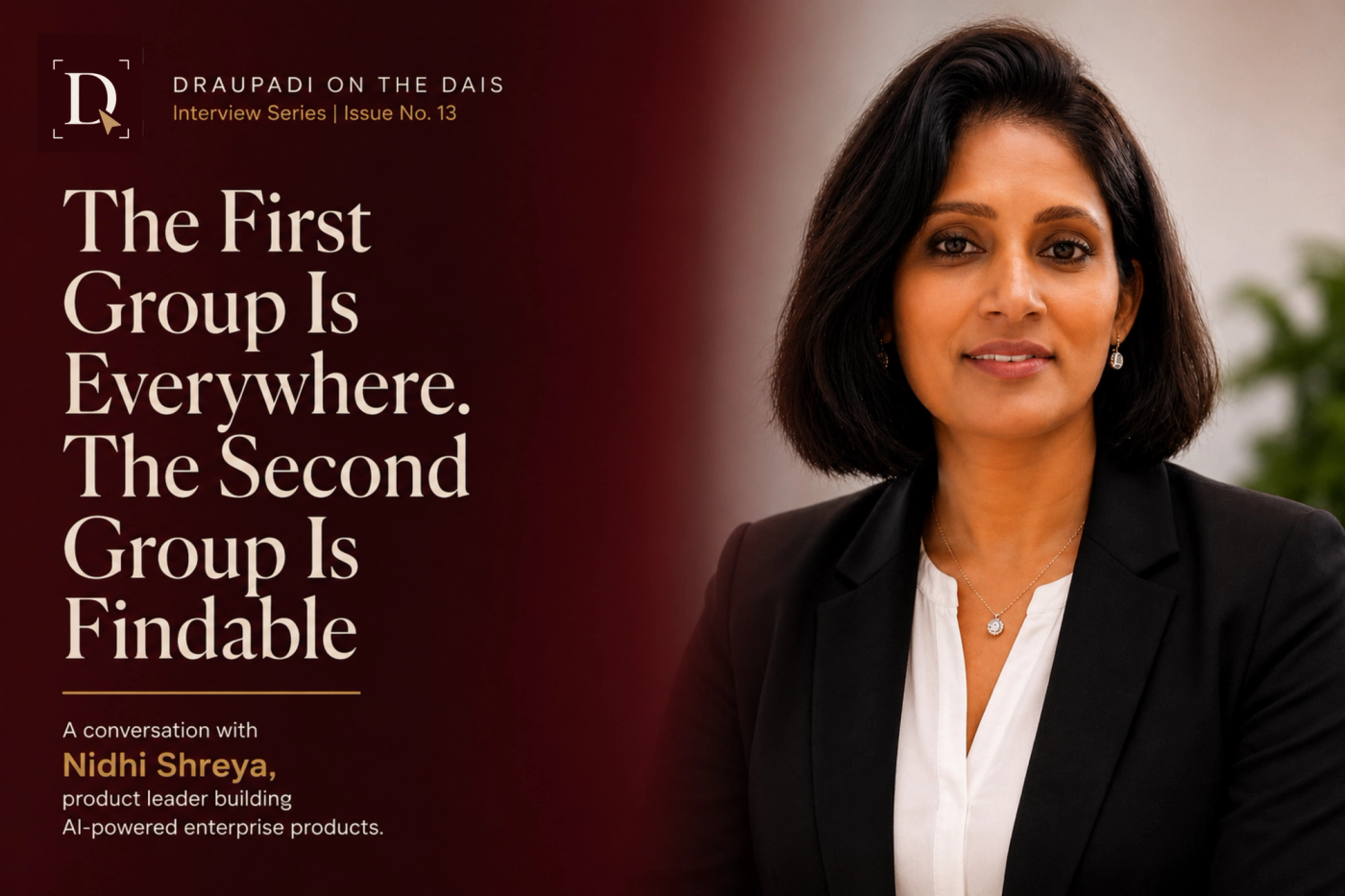
Nidhi Shreya is a product leader specializing in AI-powered enterprise products. Most recently at Simpplr, she led product initiatives across employee experience, personalization, and digital workplace innovation, helping organizations build more engaging and connected workplaces.
Reading the Room Before I’m in It
Q1. There is usually work that happens with no name on it, no metric attached, and that most people around you probably do not notice. What is the most important thing you do that fits that description?
Apart from constant collaboration and finding alignment with no metric attached to it, there is another thing that stands out.
It takes place before the meeting. And, there are a lot of meetings in product work, and quite a few of them carry real weight. A decision to be made, a direction to be aligned on, a team to be brought along.
And the work that actually makes those meetings land? It happens silently before anyone enters the room. I spend a lot of time reading the room before I’m in it. Who are the people I’m walking into? What actually motivates them? What are they worried about, what do they need to feel confident, and what language do they think in?
Because you cannot walk into a room with one single narrative and expect it to land across the board.
With a sales team, I’m talking about deals, win rates, loss reasons, what’s coming up in prospect conversations and how this helps them close. With customer success, I’m talking about resolution, trust, unblocking their team so they can actually do their job. With designers and engineers, it’s more focused on what and how?
Basically, same proposal yet a completely different conversation.
No one sees that preparation. There’s no metric for it, no credit attached to it. But I’ve seen what happens when it’s missing, the meeting that should have been a decision becomes another round of misalignment. The work I did beforehand is exactly what prevented that.
It doesn’t show up anywhere. But it’s some of the most important work I do.
The Discovery Work That Happens Before the Real Work Begins
Q2. You are known for product in employee experience and talent acquisition tech. But there is often a project underneath the project, something you are building that does not have a job title attached to it. What is it?
The discovery work that happens before the real work begins.
At Simpplr, we were planning a significant initiative, transforming a static homepage into a flexible, highly personalised digital workplace for employees. That was the visible project. But before a single line of code was written, before anything went on the roadmap, there was another project running quietly underneath it.
We ran a five day design sprint. But even before the sprint started, we spent time going back through a full year of customer usage data, support tickets, and feedback, collating everything connected to the problem we were trying to solve. We walked in prepared, not guessing.
On day one we spoke to five key customers. We watched how they actually moved through the product, where they got stuck, what they wished existed, what they considered non-negotiable. Patterns started emerging, we identified five to eight distinct pain points and made a deliberate choice to focus on the top three.
From day two onwards, we started ideating. Solutions grounded in what customers had actually told us, layered with existing survey data. We prototyped. And then, this is the part I think matters most, we went back to customers on day three and four and showed them what we had built. Not to impress them. To pressure test it before we committed.
They responded well. They felt like we were actually listening to them. That signal alone told us we were moving in the right direction.
By day five we had clarity on direction, soft launch approach, and key milestones. The sprint brought together user research, design, engineering, architecture, sales, and customer advocacy, all in one room, all pointed at the same problem.
Nobody called that sprint a project. It had no launch, no announcement. But without it, the initiative that followed would have been built on assumption. That quiet work underneath became the foundation of the key projects that we shipped later.
We Don’t Command, We Persuade
Q3. What is the most widely held belief in your field that you quietly, or not so quietly, disagree with?
This will certainly be the cliche “The Product Manager is the CEO of the product.” In reality, the truth is far from it. PMs need to influence and lead a lot of people, but they do it without any formal authority, and that’s exactly where the distinction lies.
A CEO has the authority to decide the what, the how, and the when, and the team follows. A PM has to earn every single one of those decisions through negotiation, data, insights, and sheer convincing power. We don’t command; we persuade.
If anything, it’s the harder job. But calling it “CEO” sets up a false expectation that does more harm than good, especially for people new to the field.
You Have to Make Yourself a Little Easier to Find
Q4. Have you ever watched someone with a thinner CV get called into a room you should have been in? What did that teach you about how discovery actually works?
I have seen it played out on more occasions than I would like to admit. It isn’t always the most experienced person in the room. It is the most visible one. The one people had somehow encountered, heard about, interacted with, remembered.
This led me to an uncomfortable yet important realisation: being very good at your work is necessary, but it is rarely sufficient. The right people need to know you exist, and more than that, they need to have a reason to think of you when the moment arrives.
There was no single turning point for me. It was a realisation over a period of time. And it quietly pushed me to write more, speak more, connect more intentionally, and show up in spaces, forums, communities, events, not just as an attendee but as someone willing to lead or contribute. Not to perform visibility, but because I genuinely had something to say and wanted to share with others.
Discovery, I’ve realised, rarely finds you. You have to make yourself a little easier to find.
The First Group Is Everywhere. The Second Group Is Findable.
Q5. There is a version of visibility that requires performance, constant output, constant presence. And there is another version that is just being findable in the right places. How do you think about the difference?
Take LinkedIn as an example, because I think it plays out very visibly there.
There’s one set of people who post every day, sometimes multiple times a day. The focus isn’t really on what they’re saying, it’s on being seen. A motivational quote, a forwarded message, a “this” with someone else’s post or plain AI slops. Constant presence, constant output.
And then there’s another set. They’ve found a specific corner they actually care about and they speak from there. Their posts may not always look polished. They’re sometimes short. But they come from real experience, real stories, real learning, and they have something in them that’s worth sitting with.
The first group is everywhere. The second group is findable.
That’s the distinction for me. One is about pushing yourself into people’s feeds. The other is about creating a space that means something, so that when the right opportunity or the right person comes along, they know exactly where to find you and why.
I’ve always been more drawn to the second. Not because performance is wrong, but because I don’t have the energy for presence that has nothing behind it.
The Work Will Speak for Itself. It Doesn’t. Or at Least, Not Loudly Enough.
Q6. There is a kind of credibility that accumulates quietly, through work done over years, that still does not translate into the right invitations. Where do you think that gap lives?
This question really speaks to me.
There was a time when experience alone was enough. You did good work, you built a track record, and the next opportunity found you. That was the implicit deal, show up, deliver, and credibility would open the right doors.
But that deal has quietly changed.
The gap, I think, lives in the distance between what you’ve built and who knows you’ve built it. You can have fifteen years of excellent work behind you and still be invisible to the people making decisions, because you never invested in the network that would have sponsored you, vouched for you, or simply thought of you when the right room opened up.
And the painful part is the timing. Most of us realise this too late. We spend a decade, sometimes two, getting really good at the work. And somewhere along the way we tell ourselves that the work will speak for itself. It doesn’t. Or at least, not loudly enough.
By the time you understand that you need a network, the people you worked with five or ten years ago have moved on. You’re not on their radar anymore. Rebuilding those threads is harder than it sounds, not impossible, but hard.
What gives me some hope is watching the newer generation figure this out earlier. They’re not waiting to be discovered. They’re building connections intentionally, from the start, not as a transaction, but as a habit.
That’s the gap. And honestly, most of us who are mid-career are still quietly dealing with it.
Not Louder. Not More Decorated. Just More Certain of What I Stand For.
Q7. Five years from now, you are in a conversation with someone whose judgment you trust. Not a performance review, just an honest conversation. What do you want to be able to say about this period?
Five years from now, I’m not picturing a product executive evaluating me. I’m picturing a friend, someone who actually knows me, and what I want them to say is simple. That I became more assured. That my decisions got sharper, my opinions more grounded, and I stopped second-guessing myself as much as I used to.
But beyond that, and this matters more to me, I want them to say that my impact wasn’t just contained to the product I was working on. Those people who worked with me, read what I wrote, or heard me speak somewhere walked away with something. Not because I performed well, but because what I said came from a real place. They should feel that I was honest. That I spoke from experience. That I showed up with empathy and could meet people where they actually were, not where it was convenient to assume they were.
That’s the version of myself I’m working towards. Not louder. Not more decorated. Just more certain of what I stand for, and more visible proof that it made a difference to someone.
Nidhi Shreya is a product leader specializing in AI-powered enterprise products.