You Have to Be Willing to Be Found
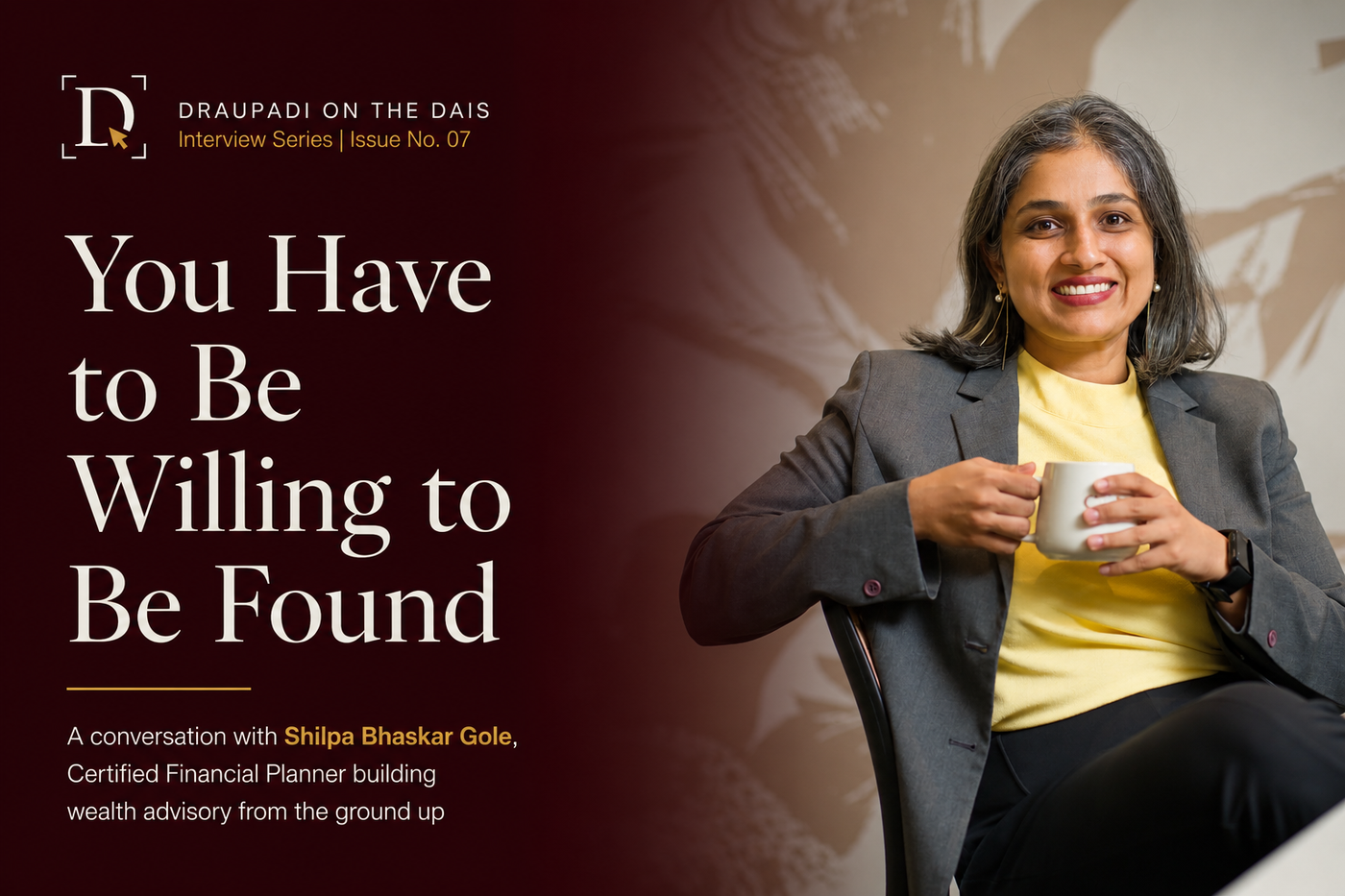
Shilpa Bhaskar Gole is the Founder and Managing Partner of NerdyBird Wealth Advisory, a SEBI-registered investment advisory. A Certified Financial Planner and Financial Fitness Coach, her earlier career spanned rural financial inclusion at KGFS, agribusiness incubation in Marathwada, and communications work at IRMA.
That Impact Fueled Me to Do More
Q1. You have built real expertise in a specific area over a long time. When did the work start feeling like yours, not just something you were doing?
The work started feeling like mine when I started drawing energy from it.
What gave me that energy was seeing the transformation in my clients. Seeing them build wealth. Seeing them move from confusion to action. Seeing that something I said to them actually helped them take the next step.
I think that action bias became a very important part of my work. I did not want financial planning to remain theoretical or intellectual. I wanted it to help people do something with more clarity and confidence.
When I saw that my work was moving people towards action, I started feeling the impact of it. And that impact fueled me to do more.
That is when the work stopped feeling like something I was doing and started feeling like something that was mine.
Design a Life That Does Not Need to Be Compared
Q2. Most careers have a decision that looked wrong from the outside and turned out to be exactly right. What was yours, and what did it teach you that no formal experience could have?
I think the decision was to choose my values very intuitively, even when that may not have looked like the most obvious career move from the outside.
Most careers teach you to be career-focused. They teach you to grow, compete, achieve, and compare yourself with peers. But they do not always teach you to design a life that honours your values first.
For me, that became the most important thing.
Once I started honouring my values, it changed the way I looked at work. I realised that when your life is aligned with what truly matters to you, you show up much better professionally as well. You are not constantly trying to live someone else’s version of success.
It also helped me design a life that does not need to be compared with anyone else’s. I think that has been very freeing.
A conventional career path can make you look sideways all the time. What is someone else doing? Where have they reached? How fast are they growing?
But when you know your own values and your own goals, the comparison drops. It becomes about your path, your work, your impact, and what lies ahead of you.
That is something no formal experience could have taught me in the same way.
Good Systems Create Consistency
Q3. You are known for financial life planning, but there is often a project underneath the project, something you are building that does not have a job title attached to it. What is it?
Right now, the project underneath the project is systems.
I am trying to build systems that allow this work to scale without losing the care, depth, and personal attention that make it meaningful in the first place.
Financial life planning is deeply human work. It requires listening, context, trust, and the ability to hold complexity with clarity. But if it remains entirely dependent on one person holding everything in her head, it cannot grow beyond a point.
So I am in a phase where I am building processes, frameworks, and ways of working that can support more clients and more impact.
It may not sound glamorous, but to me it feels very important. Because good systems create consistency. They reduce chaos. They allow a team to work with clarity. And they allow the client experience to remain thoughtful even as the practice grows.
So the visible work is financial life planning. But underneath that, I am building the foundation for scale, sustainability, and deeper impact.
You Have to Be Willing to Be Found
Q4. At some point in a woman’s career, the question stops being whether she has what it takes and starts being whether the right people can find her. When did you notice that shift for yourself?
I noticed that shift quite early.
Maybe it was because of the inner work I had been doing, and the kind of learning I was absorbing at the time. I realised that I had the competencies. What I needed was to put myself out there.
So I started reaching out.
I connected with people on LinkedIn. I wrote cold emails. I sent cold DMs. I reached out to news anchors, CEOs, decision makers, and leaders in organisations.
But I did not do it in a way that felt salesy or forced. I reached out from a place of genuine appreciation, curiosity, and connection. Sometimes it was simply to say that I admired their work. Sometimes it was to ask an honest question. Sometimes it was to share what I was building and ask for an opportunity.
Those conversations opened doors for me.
I think that was when I understood that capability and visibility are two different things. You may have the competence, but people still need to know that you exist, what you stand for, and what kind of work you can do.
For women especially, I think this is an important shift. Many of us are conditioned to believe that if we keep doing good work quietly, the work will somehow find its way to the right people. Sometimes it does. Very often, it does not.
You have to be willing to be found.
We Help Them by Giving Them Access, Language, Tools, and Space
Q5. What is the most widely held belief in your field that you quietly, or not so quietly, disagree with?
One widely held belief I disagree with is that portfolios need constant rebalancing, rejigging, and tactical decision-making.
I think that can make finance feel more complicated than it needs to be.
There is a place for periodic review and thoughtful changes, of course. But I do not believe that good financial planning requires constant activity. In fact, a lot of the time, the better work is in keeping things simple, strategic, and straightforward.
I think people often underestimate the power of a plan that is clear, aligned, and allowed to work over time.
The other belief I disagree with is not limited to finance, but it shows up very strongly in money conversations. It is the stereotype that women are naturally good savers, natural multitaskers, natural household money managers, and therefore somehow automatically good with money.
I find these stereotypes very limiting.
Women are not one homogenous group. Some women are confident with money. Some are anxious. Some have been excluded from money decisions. Some have managed households beautifully but have never been invited into investment conversations. Some are excellent earners but still feel underconfident about wealth.
So I do not think we help women by putting them into neat boxes. We help them by giving them access, language, tools, and space to make money decisions on their own terms.
Credibility Needs Discoverability
Q6. There is a kind of credibility that accumulates quietly, through work done over years, that still does not translate into the right invitations. Where do you think that gap lives?
I think the gap lives in discoverability.
There are many people, especially women, who are doing deep, credible, meaningful work. But the right people may still not know how to find them.
So the question becomes: what are you doing to increase the probability of being found?
Are you showing up in the right places? Are you making your work easy to understand? Are you building your network intentionally? Are you having conversations beyond your immediate circle? Are you using the right platforms, the right language, even the right hashtags, so that people looking for someone like you can actually discover you?
I remember Sahil Bloom using the idea of increasing your surface area for luck. I think that applies very well here. You have to increase your surface area for opportunity.
But I also think the gap is not only individual. It also lives in networks, access, and who gets vouched for. Sometimes the people doing the most serious work are not the loudest or most visible people in the room.
So credibility is one part of it. But credibility needs discoverability. It needs distribution. It needs people who can say your name in rooms where you are not present.
That is where the gap often lives.
Presence, Music, and Listening to My Body Before It Has to Shout
Q7. What does rest actually look like for you right now, not in theory but in practice?
Rest for me right now looks like fierce time blocking.
It looks like blocking time, keeping my devices away, and winding down in the evening.
It also looks like making a commitment to myself that when my child is in the room with me, I will make an honest effort to make eye contact and talk to him. When my husband is in the room with me, I will make an honest effort to be present, make eye contact, and have a real conversation with our devices put away.
In the world we live in, where we are so hyperconnected, this is becoming harder and harder to do. But I think we all need to put in that work to stay connected. And that, to me, is restful.
Another form of rest for me is blocking two hours a week to go learn vocal music with a bunch of preteen and teenage girls. It is one of the most rejuvenating and humbling experiences to be in a room with people who are not your age and to simply be a student with them.
And the third thing is listening more closely to my body. If my body is asking for rest, I am learning to give it rest. To drop everything and go lie down, even on a workday, without treating it like a failure.
So rest for me is presence, music, and listening to my body before it has to shout.
Shilpa Bhaskar Gole is the Founder and Managing Partner of NerdyBird Wealth Advisory. This interview was conducted as part of the Draupadi on the Dais Interview Series.